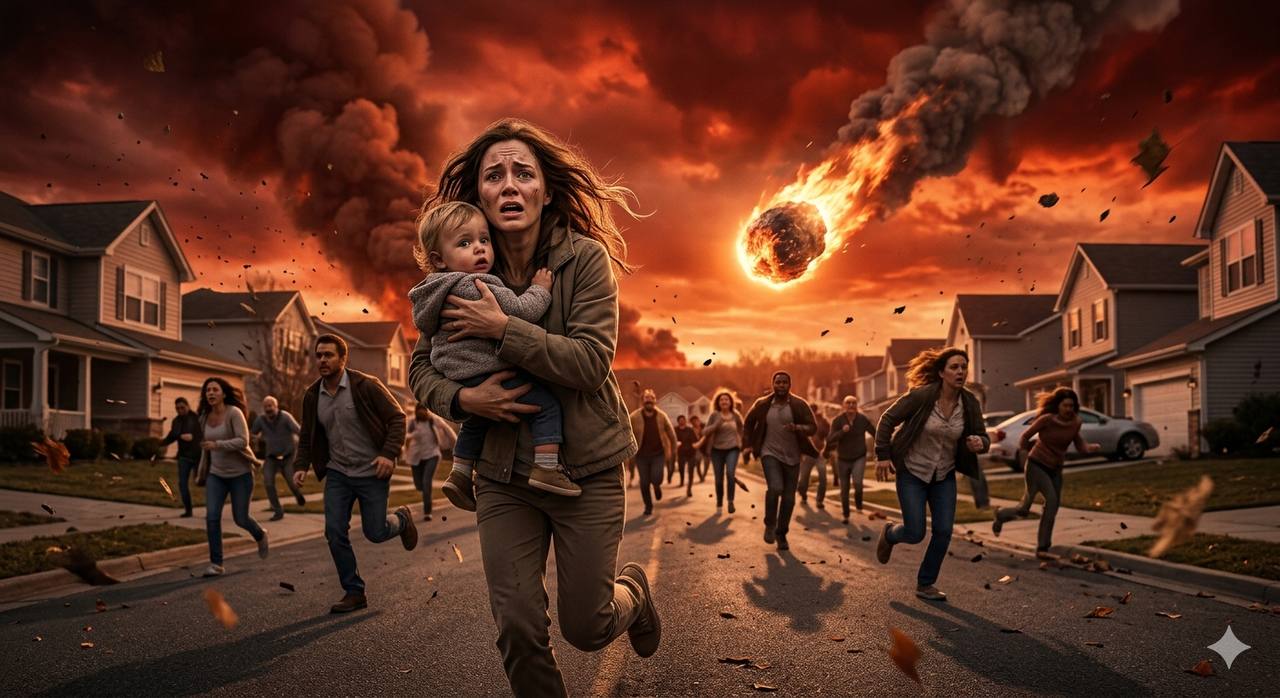
The morning of October 17, 2043, began like any other in Oakhaven, a quiet rural township nestled in the foothills of the Alabaster Mountains. Clara Thorne, a single mother of seven-year-old Leo, was preparing breakfast in their modest farmhouse kitchen when the emergency alert system blared across every device in the house. The initial message, terse and stark, warned of an imminent, high-magnitude celestial event, a direct impact predicted for the regional quadrant, with Oakhaven at the epicenter. Disbelief quickly gave way to a cold, creeping dread as the broadcast repeated, specifying a confirmed large-scale meteoroid on a collision course, just hours away.
The Amber Alert
Clara’s first instinct was to dismiss it as a drill, an elaborate test of the emergency services. Such warnings were rare, almost unheard of, in their tranquil corner of the world. Yet, the tone of the broadcast shifted, growing more urgent, the calm, automated voice replaced by a human one, strained and grave. “This is not a drill. Repeat, this is not a drill. Seek immediate shelter. Underground structures offer the highest chance of survival. Repeat…” Leo, usually boisterous, had stopped chewing his cereal, his eyes wide and fixed on his mother. He sensed the sudden shift in her demeanor, the way her hands trembled as she clutched the kitchen counter.
Turning on the television, Clara saw the national news channels had been completely overridden. A single, looping image of a rapidly approaching celestial body, rendered in stark, terrifying clarity, filled the screen, overlaid with a countdown timer. Less than three hours remained. Her mind raced, sifting through the options. The old storm cellar, built by her grandfather, sat a hundred yards behind their house. It was rudimentary, mostly used for canning, but it was deep, reinforced concrete, and crucially, underground. It was their only viable chance. She had always dismissed her grandfather’s meticulous, almost obsessive, preparations for an unspecified global calamity as an eccentric hobby. Now, in the face of the unimaginable, his foresight became their solitary beacon.
The Scramble to Shelter
Clara moved with a forced calm, masking the rising panic that threatened to consume her. “Leo, we’re going on an adventure,” she said, her voice steadier than she felt. “We need to get to Grandpa Silas’s special basement, the one for his pickles.” Leo, sensing the gravity but perhaps not the horror, nodded, clutching his favorite worn teddy bear. Clara began to gather essentials: two backpacks, one for herself, one for Leo. Bottled water, canned food, a first-aid kit, a battery-powered radio, flashlights, extra batteries, blankets. She worked methodically, her hands moving with a desperate efficiency, while the radio continued its grim litany of instructions and dire warnings. The sky outside, previously a pale autumn blue, had begun to acquire an unusual, almost bruised hue, a faint, sickly yellow that deepened towards the horizon.
As they stepped out of the farmhouse, the air was still, unnervingly so. The usual chirping of cicadas was absent. A low, guttural rumble, distant at first, began to vibrate through the ground. It was not thunder; it was something far deeper, primal, as if the earth itself was groaning. Clara hoisted Leo into her arms, ignoring his protests about being a big boy, and ran towards the cellar. The path was uneven, overgrown, but her focus was absolute. She could feel the vibrations intensifying, a tremor that rattled her bones. Overhead, the sky was no longer merely bruised; it pulsed with an eerie, flickering light, like a colossal, invisible forge had been ignited directly above them.
The Earth’s Embrace
The cellar door, a heavy steel plate rusted with decades of exposure, resisted her initially. She struggled with the latch, her fingers fumbling, until a surge of adrenaline lent her the strength. It grated open with a shriek of tortured metal, revealing a dark, earthen passage leading down. The air was cool, damp, and smelled of soil and old concrete. “Go, Leo, go!” she urged, pushing him gently towards the opening. He scrambled down the narrow, rough-hewn steps. Clara followed, pulling the heavy door shut behind her just as the first, more localized impacts began to register.
The world outside became a cacophony of sound. A searing, blinding flash of light penetrated the small gaps around the door, followed by a concussive blast that shook the entire structure. Dust rained down from the ceiling, gritty against her skin. The rumble intensified into a deafening roar, a sound that seemed to tear at the fabric of existence. It was not a single explosion but a rapid succession of monstrous detonations, each one followed by a wave of pressure that threatened to buckle the cellar’s walls. Leo whimpered, burying his face in her side. Clara wrapped him in a tight embrace, shielding his head, her own ears ringing with the sheer force of the sound. The air grew thick with dust and the acrid smell of ozone and burning rock. Then, almost as suddenly as it had begun, the most violent phase subsided, leaving behind a profound, ringing silence, broken only by the distant, sporadic thud of secondary impacts and the slow creak of settling earth. They had made it inside. Barely.
A New Reality Below
In the absolute darkness, Clara fumbled for a flashlight. Its beam cut through the thick dust, revealing a cramped, but functional space. The cellar was small, perhaps ten feet by fifteen, with shelves lining the walls, mostly empty save for a few forgotten jars of pickles and some gardening tools. Her grandfather had installed a rudimentary ventilation system, a hand-cranked fan connected to a pipe leading vaguely upwards, and a small, bolted-down chemical toilet. A cot and a few dusty blankets comprised the sleeping arrangements. It was spartan, but it was solid. The walls, made of reinforced concrete blocks, seemed to have held.
“Mommy, what was that?” Leo’s voice was small, trembling. Clara knelt, pulling him closer. “It was just a big, loud storm, sweetheart. But we’re safe here, just like Grandpa Silas planned.” She checked him over, reassuring herself that he was unharmed beyond the shock. His eyes, in the flashlight beam, reflected the fear she felt. For the next few hours, they simply sat, listening. The silence outside was pervasive, an unnatural stillness that spoke volumes. The occasional distant thud, a metallic clang from deeper within the earth, was the only reminder of the chaos they had just escaped. Clara tried the battery-powered radio, tuning through the frequencies. Nothing but static. The airwaves were dead. This silence was more terrifying than the noise had been.
Days in the Dark
The first few days in the bunker blurred into a monotonous cycle of rationing water, eating cold canned food, and listening to the unyielding static of the radio. Clara tried to maintain a semblance of routine for Leo. She read him stories by flashlight, played quiet games, and made him practice his letters in the dust on the floor. His initial fear slowly morphed into a subdued curiosity, though he often asked when they could go home, when they could see the sun again. Clara offered vague answers, her heart aching with the uncertainty. She had no idea what awaited them outside, or if there was even an ‘outside’ left to return to.
Her own anxieties mounted with each passing day. The air, though circulated by the hand-cranked fan, felt heavy, stale. The limited space began to feel oppressive. Sleep offered little respite, haunted by vivid flashes of the sky turning crimson, the earth shaking. She worried about radiation, about breathable air, about the structural integrity of the bunker under constant, unknown pressure. The lack of any external communication was the most unnerving. No emergency broadcasts, no faint signals, just the relentless hiss of dead air. It suggested a catastrophic, widespread event, far beyond what she had initially comprehended.
The Question of Return
After nearly two weeks, the silence outside remained unbroken. The sporadic thuds had ceased. Clara knew their supplies, though carefully rationed, would not last indefinitely. The decision to attempt surfacing, once a distant possibility, now loomed as an urgent necessity. The risks were immense: toxic atmosphere, unstable ground, unknown dangers. But remaining indefinitely below ground was not an option. She spent days debating, weighing the slim chances of survival outside against the slow, inevitable decline within the bunker.
One morning, she told Leo their adventure would soon take them back up. She tried to make it sound exciting, a new part of the game. He seemed to accept it with the resigned innocence of a child dependent entirely on his parent. Clara found her grandfather’s old Geiger counter, a bulky, archaic device, among the forgotten tools. It hummed to life, its needle steady, indicating no immediate, lethal radiation levels within the bunker. It was a small, fragile comfort. She also located a respirator mask and a heavy-duty wrench. The heavy steel door, their only barrier to the unknown, felt impossibly heavy under her hand.
She explained to Leo that they would open the door slowly, just a crack, and listen. They would assess the air, the sounds, the light. If it seemed safe, they would proceed. If not, they would seal it again and wait longer. The plan was simple, almost naive, but it was all she had. With a deep, shuddering breath, Clara braced herself. The wrench felt cold and heavy in her hand. She positioned it against the rusted mechanism of the latch, the only thing separating them from whatever remained of the world above. The time had come to face the silence, to confront the new reality of Oakhaven, or perhaps, what was left of it.
Notes & sources
- · Story is fictional. Names, locations, and events are invented.
This story is a dramatized retelling. Some details, names, and locations have been changed or invented for narrative purposes.