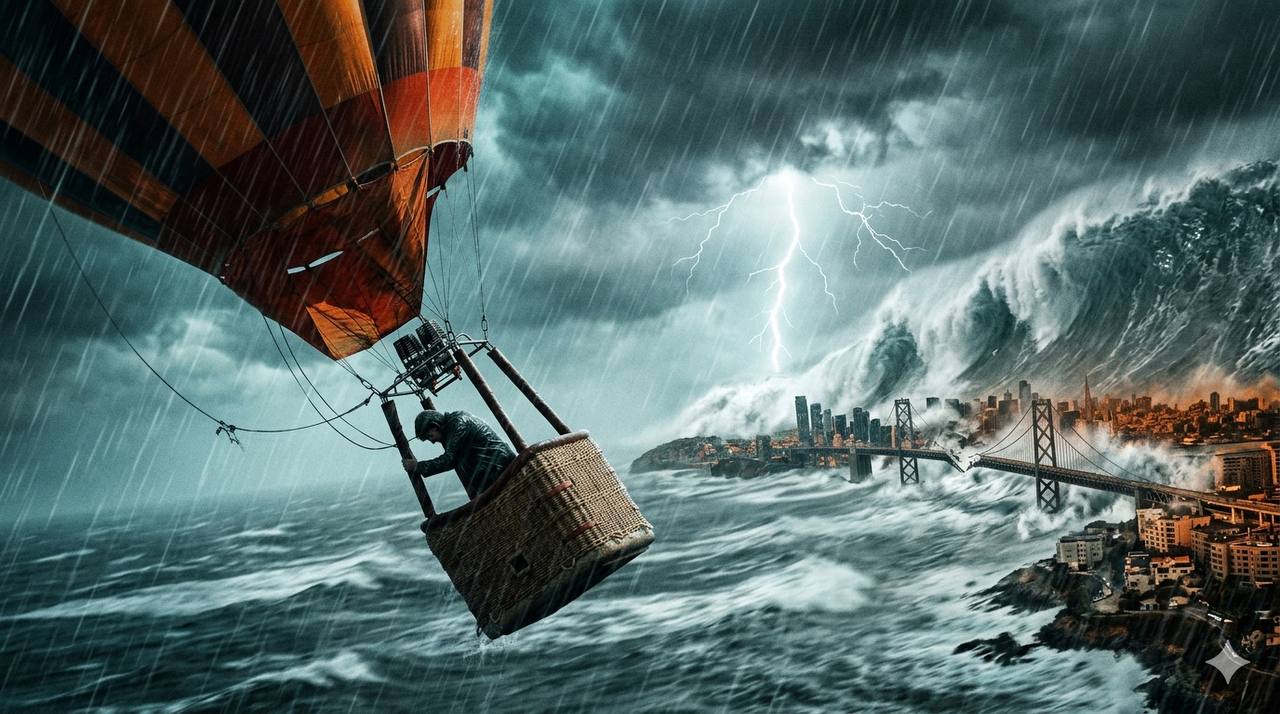
On the morning of July 14, 2042, Elara Vance woke to the sound of an unfamiliar, insistent alarm blaring from her weather console. Her home, a modest bungalow in the coastal town of Havenwood, had always been a bastion against the mild, predictable shifts of the Pacific Northwest. Today, however, the sky was a bruised purple-black, and a wind unlike any she had ever experienced howled like a banshee through the pines. Before the local emergency broadcast could issue its truncated, panicked warning, the first wall of water, a dark, churning mass, slammed into the shoreline, erasing everything in its path. Her son, Liam, aged eight, and daughter, Clara, five, were still asleep, oblivious to the world outside that was already beginning to drown.
The Unfolding Deluge
The initial impact was a deafening roar, a sound that seemed to tear at the very fabric of the air. Elara, a former marine biologist, had studied countless storm patterns, but nothing in her training or experience had prepared her for this. The water, a frothing, debris-laden torrent, surged through the front door, instantly transforming the ground floor into a churning river. Instinct took over. She grabbed Liam and Clara from their beds, their small bodies limp with sleep, and scrambled up the narrow staircase. The house groaned, wood splintering, as the current tore at its foundations. Their only refuge was the attic, a cramped, dusty space accessible by a pull-down ladder. As she hauled the children through the opening, the water was already licking at the top step. From the small, grimy attic window, she watched in horror as Havenwood, a town of quiet streets and familiar faces, dissolved into a chaotic seascape of splintered wood, upturned vehicles, and the occasional, heartbreaking glimpse of a roof being dragged away by the current. There were no sirens, no rescue helicopters. Only the ceaseless roar of the storm and the rising water.
Adrift on a Liquid World
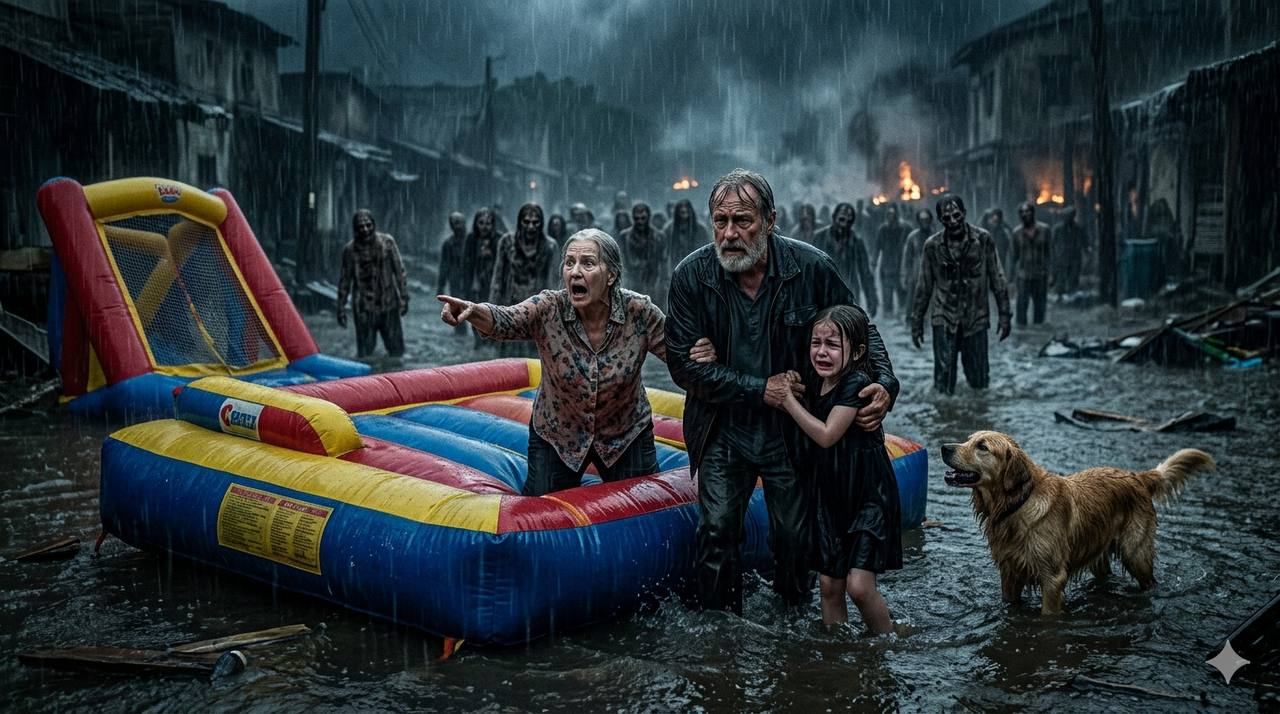
The days that followed blurred into a grim cycle of survival. The attic, initially a sanctuary, became a trap as the water continued its relentless ascent, eventually breaching the floorboards. Elara, in a desperate, frantic effort, managed to pry loose several large sections of the attic wall paneling, binding them together with electrical cords and torn bedsheets. It was a crude raft, barely buoyant, but it was their only hope. With Liam clutching a small backpack containing a few cans of peaches and a gallon jug of water, and Clara bundled in a waterproof blanket, they pushed off into the turbulent expanse that was once their street. The world outside was an endless, grey-green ocean, dotted with the grotesque remains of human habitation. Distant lights, perhaps from other trapped survivors, flickered sporadically before winking out, one by one. The storm, relentless and unyielding, seemed to have no end. Rain lashed down in sheets, blurring the horizon into an indistinguishable haze of sky and sea.
They drifted for what felt like an eternity. The sun, when it occasionally pierced the thick cloud cover, offered little warmth, only a stark, unwelcome illumination of their predicament. Food and water became precious commodities, portioned out in agonizingly small amounts. Liam, usually boisterous, grew quiet, his eyes wide and fixed on the chaotic water around them. Clara, too young to fully grasp the enormity of their situation, would sometimes ask for their cat, Mittens, or wonder when Daddy would come home. Elara would offer a reassuring squeeze, a whispered promise she wasn’t sure she could keep. Her focus narrowed to the immediate: keeping them fed, keeping them hydrated, keeping them sane. Sleep was a luxury she rarely afforded herself, always vigilant, always scanning the horizon for anything – land, a ship, another survivor – that might offer a glimmer of hope.
Echoes of a Lost Civilization
On the fifth day, a strange sight emerged from the mist: the skeletal remains of a massive cargo ship, listing heavily, its bow submerged. It was a ghost, a hulking monument to a vanished world. Elara steered their flimsy raft towards it, her heart pounding with a mix of fear and desperate hope. Perhaps there were supplies, or even other people. As they drew closer, the silence was profound, broken only by the creak of stressed metal and the lapping of waves. The ship was deserted, its cargo holds gaping empty, its navigation bridge shattered. Yet, as they explored, Elara found evidence of recent occupation: a half-eaten can of beans, a tattered blanket, a child’s drawing of a smiling sun tacked to a bulkhead. Someone had been here, recently. The thought, initially comforting, quickly turned chilling. Where had they gone? Had they been rescued, or had the ocean simply claimed another victim? The ship offered no answers, only a stark reminder of the widespread devastation. They took what they could – a rusty multi-tool, a coil of rope, a few more bottles of water – and continued their journey, the ghost ship fading behind them into the perpetual grey.
The Infinite Horizon
Weeks turned into an indistinct blur. The constant rocking of the raft became their new normal, the taste of salt ever-present. The storm, though occasionally receding, never truly broke. It was as if the entire atmosphere had shifted, locking the world into a state of perpetual tempest. Liam, ever resourceful, fashioned a makeshift fishing line from a shoelace and a bent paperclip, managing to catch small, silvery fish that Elara cooked over a small, salvaged emergency stove. It was a meager diet, but it kept them alive. Clara often sang quiet, tuneless songs, a small, defiant spark of childhood in an otherwise desolate landscape. Elara found herself talking aloud, narrating their surroundings, describing non-existent islands, telling stories of the life they once knew, all to keep their spirits from succumbing to the crushing weight of their isolation. The vastness of the ocean, stretching endlessly in every direction, began to feel less like a temporary passage and more like a permanent, inescapable reality.
A Fading Signal
One evening, as the sun dipped below the horizon in a spectacular, blood-orange display, a faint, rhythmic pulse caught Elara’s attention. It was a light, distant and barely perceptible, flashing in a steady sequence. Not a lightning strike, not the glint of debris. It was a signal. Her heart leaped with a hope she had almost forgotten. She frantically searched through their meager belongings, finding the rusted multi-tool. Using its small, reflective surface, she attempted to flash back, a desperate, silent plea across the miles of churning water. For hours, she continued, her arm aching, her eyes straining, until the light, as mysteriously as it had appeared, vanished into the deepening twilight. Had it seen them? Was it even a distress signal, or just a trick of the light? The incident left her with a renewed sense of urgency, a desperate, almost primal drive to find land, to find answers, to find a future for her children.
The Unseen Current
Their supplies, meticulously conserved, were now critically low. The last of the water jug was nearly empty, and the canned peaches were a distant memory. Liam had grown thin, his usually rosy cheeks pale and sunken. Clara, though still singing, often coughed, a dry, persistent sound that worried Elara more than anything else. A new current had caught them, pulling them steadily towards the north, towards colder, more treacherous waters. Elara scanned the horizon with a renewed intensity, every ripple, every shadow a potential sign of land or danger. She thought of Havenwood, of her garden, of the comfortable predictability of her old life. It was a distant dream, a memory from a world that had ceased to exist. Their survival now depended not just on her ingenuity, but on an unseen force, a current both physical and metaphorical, carrying them into an unknown future.
Days later, the sky remained a uniform grey, the ocean a relentless expanse. They were still adrift, a tiny speck on an indifferent, endless sea. The land, if it existed, was still beyond their sight, a promise whispered on the wind. Elara held her children close, their small bodies a comforting weight against her own. The storm raged on, a permanent fixture in their new reality. They were alone, suspended between the vastness of the sky and the unfathomable depths below, the question of what remained of the world, and indeed, of their own future, hanging in the desolate air. The journey continued. The answer remained elusive. The ocean kept its secrets. The new world waited. With each passing wave, they were carried further into the silence. Her gaze remained fixed on the horizon, searching for any sign, any indication, of what lay beyond the mist. It was a hope, fragile but persistent, in a world that offered little else. They were still moving. That was enough, for now. The vast, grey expanse continued to swallow the light. They simply continued to drift. The story of their survival, if it were ever to be told, remained unwritten, unfolding wave by solitary wave. The world had ended, and they were still in it.
Notes & sources
- · Story is fictional. Names, locations, and events are invented.
This story is a dramatized retelling. Some details, names, and locations have been changed or invented for narrative purposes.