On November 12, 2047, at approximately 07:18 local time, Elara Vance secured the main entrance to the Oakhaven Botanical Conservatory. The heavy steel-framed glass doors, usually welcoming, now served as a final barrier against the escalating chaos outside. For three weeks, she had been moving north from the outskirts of Freeport, driven by increasingly desperate reports of safe zones that invariably proved false. The conservatory, an imposing structure of steel and glass nestled in a remote valley outside the abandoned town of Oakhaven, represented her last viable option for shelter. Its primary purpose had been the preservation of rare flora, a mission now rendered irrelevant by the larger, more immediate imperative of human survival.
The Illusion of Safety
Elara’s initial assessment suggested a degree of security. The conservatory’s walls, constructed from reinforced laminated glass panels, rose to an apex of nearly fifty feet, designed to withstand local wind shear and minor seismic activity. The primary access points were heavy, multi-bolt industrial doors, and the complex was surrounded by a ten-foot-high wrought iron fence, ornamental but robust. Inside, the controlled environment maintained a consistent warmth and humidity, a stark contrast to the biting autumn air outside. The air filtration system, still partially operational thanks to a backup generator, offered a faint, metallic hum that masked the distant, guttural sounds. For the first few days, the silence inside was profound, broken only by the drip of condensation from the high ceilings and the rustling of exotic plant leaves. She found a small, utilitarian office space in the maintenance wing, equipped with a cot, a shortwave radio, and a surprisingly intact supply of emergency rations. It was here, amidst the verdant labyrinth of tropical plants and temperate ferns, that Elara permitted herself the brief luxury of believing she had found sanctuary.
The Shifting Landscape Outside
Her initial sense of security began to erode on the fifth day. Through the vast glass panes of the main dome, Elara observed the movement. Not the casual wanderings she had grown accustomed to seeing in the abandoned towns, but a more deliberate, almost migratory flow. The infected, or ‘Revenants’ as the last government broadcasts had termed them, were converging. Their numbers grew steadily over the next week. First, isolated figures shambled across the distant meadows, then small groups, eventually coalescing into a slow, undulating tide that lapped at the conservatory’s perimeter fence. They were drawn by an unknown stimulus, perhaps the residual hum of the generator, or merely the path of least resistance. Their constant, low groans, initially a background murmur, became a pervasive, unsettling drone. Elara spent hours at the observation windows, a pair of scavenged binoculars pressed to her eyes, meticulously documenting their patterns, their numbers, their vacant, persistent movements. The glass, once a transparent shield, now felt like a magnified lens focusing her predicament.
The Silent Siege
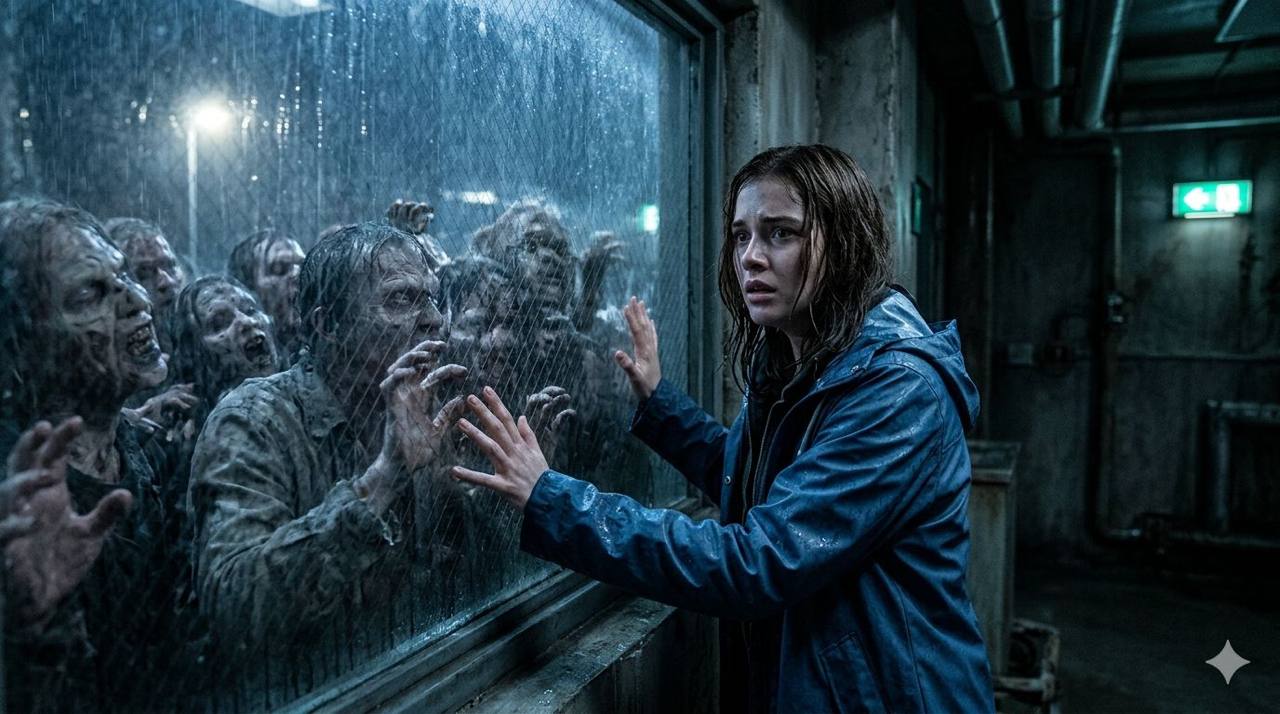
With the perimeter fence breached on the fourteenth day of her residency, the situation escalated from theoretical threat to tangible siege. The Revenants, driven by a relentless, unthinking impulse, pressed against the exterior glass. The reinforced panels, while sturdy, were not designed for sustained, distributed impact. Small cracks began to spiderweb across some lower sections. Each new fracture, however minute, resonated through the structure, a tangible countdown. Elara moved her sleeping quarters to the upper levels of the display house, utilizing a suspended walkway that offered a vantage point and a degree of separation. Her rations, carefully portioned, were dwindling. The shortwave radio, her last link to a world that might still exist, remained silent save for static. The psychological toll of the constant, unblinking observation through the glass was profound. The Revenants outside were not actively attempting to break in, but their mere presence, their ceaseless, slow-motion press, created a crushing sense of inevitability. The sheer weight of their collective, unthinking hunger was the weapon.
An Unforeseen Vulnerability
One afternoon, approximately twenty-eight days after her arrival, Elara witnessed a new development. A large male Revenant, distinguished by the remains of a tattered postal uniform, began striking a specific lower panel with a sustained, rhythmic force. It was not a random action. It appeared to have located a weakness, perhaps a micro-fracture or a slightly ill-fitted section. The other Revenants, as if sensing a focal point, began to emulate its actions, their collective, clumsy blows echoing through the structure. The sound was no longer a distant thrum but a direct, percussive assault. The targeted glass panel, positioned near the main humid tropics exhibit, developed a network of deeper fissures, radiating outwards from the point of impact. Elara knew the integrity of the entire structure relied on the distribution of stress. A single catastrophic failure could lead to a cascading collapse. She considered her options, which were few and unappealing. The maintenance tunnels beneath the conservatory were a possibility, but their exits were unknown and likely compromised.
The Price of Observation
Her days became a cycle of observation, repair attempts with salvaged epoxy, and the conservation of dwindling resources. The humidity within the conservatory, once a comfort, now felt cloying, a constant reminder of the enclosed space. The air grew heavy with the scent of damp earth and decaying plant matter, mingled with a faint, metallic tang. She rationed her emergency light sources, relying mostly on the fading natural light filtering through the increasingly smudged and cracked glass. Sleep offered little respite, haunted by the imagined sound of breaking glass. The irony of her situation was not lost on her: she was surrounded by life, vibrant and green, yet utterly alone, trapped by the very transparency that allowed her to witness the slow demise of the world outside. The silence, once a luxury, had become a suffocating presence, punctuated only by the relentless, monotonous pressure against her fragile sanctuary.
She began to notice subtle shifts in the Revenants’ behavior. They seemed to press more intently at night, their empty eyes reflecting the faint, internal glow of her last remaining emergency lantern. The glass, which had once felt like an impenetrable barrier, now seemed merely a thin, fragile skin separating her from an indifferent, insatiable world. The cracks continued to spread, slow and methodical, like veins across a dying landscape. Elara found herself tracing their progress with her fingertips, a silent acknowledgment of the forces at work. The conservatory, once a symbol of humanity’s attempt to control and preserve nature, was now merely a temporary, transparent vessel, adrift in a sea of persistent hunger. Her vigil continued, the glass a constant reminder of both her visibility and her isolation, the world outside pressing in with an almost geological patience.
Notes & sources
- · Story is fictional. Names, locations, and events are invented.
This story is a dramatized retelling. Some details, names, and locations have been changed or invented for narrative purposes.