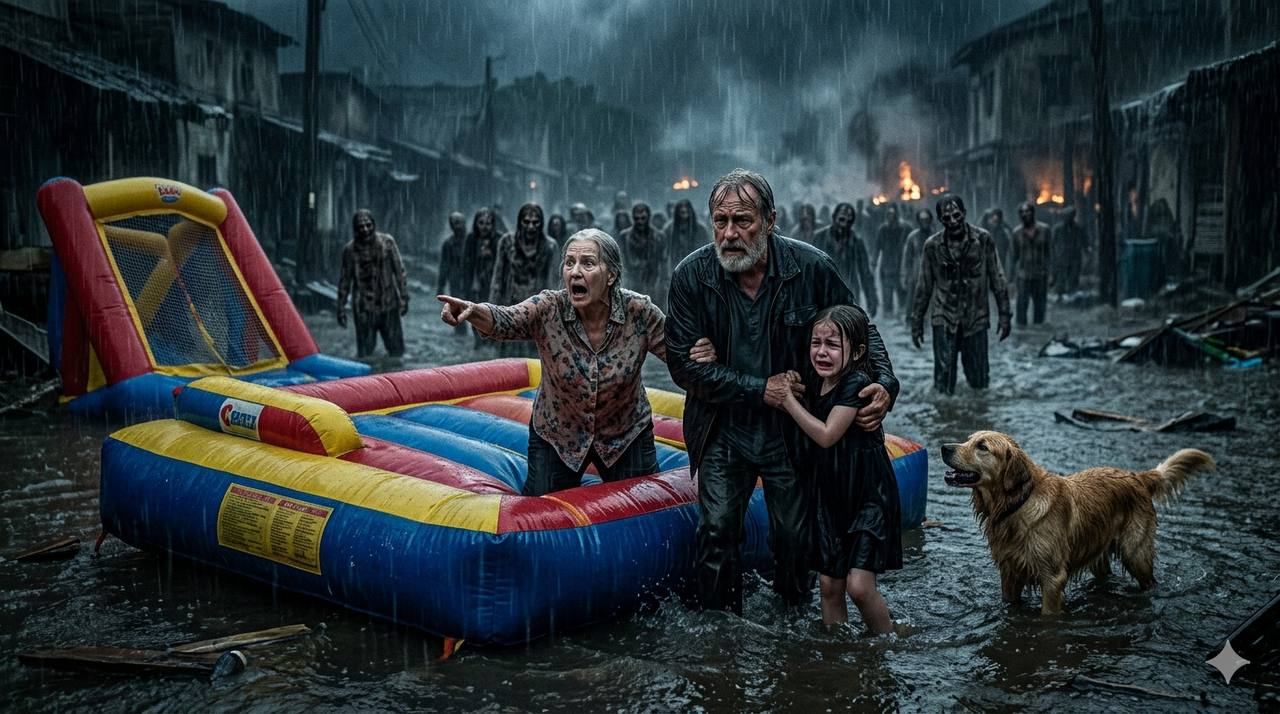
On the afternoon of October 27, 2047, in the coastal town of Port Lyra, the rising waters of the Great Deluge reached the second-story windows of the Vance residence. For weeks, the family—Elara Vance, her husband Marcus, their eight-year-old daughter Lena, and Elara’s septuagenarian father, Silas Thorne—had contended with the unprecedented inundation. News broadcasts had ceased; emergency services were overwhelmed. Below their fortified upper floor, the flooded streets teemed with aggressive, mutated creatures, a byproduct of the same environmental collapse that had triggered the global sea-level rise. Desperation was a constant companion, until Silas, a man whose quiet eccentricities once included an amateur’s passion for aerostats, presented his improbable solution.
The Deluge and Desperation
Before the Deluge, Port Lyra had been a picturesque community, known for its seafood markets and maritime history. The Vances had lived a comfortable existence in a sturdy, pre-war house on Elm Street. When the initial reports of accelerated polar melt began to materialize into tangible threats, few had anticipated the speed and scale of the catastrophe. Within three months, coastal cities worldwide were partially submerged. The phenomenon was not merely a rise in sea level; it was accompanied by a biological shift, giving rise to the ‘ferals’—rapidly evolving, predatory organisms that thrived in the new, waterlogged ecosystems.
Their initial survival was a testament to Marcus’s foresight and Elara’s meticulous planning. They had stockpiled non-perishables, purified water, and reinforced their home’s upper levels. Yet, as the weeks bled into a month, then two, resources dwindled. The outside world was a blur of grey water and shifting debris, punctuated by the guttural cries of the ferals. Hope, a finite commodity, began to erode. Lena, usually a vibrant child, had grown quiet, her gaze often fixed on the swirling currents outside the window. It was in this atmosphere of quiet despair that Silas Thorne, a man whose physical strength had long since waned, revealed a tenacity of spirit that surprised even his own daughter.
Silas’s Improbable Vision
Silas Thorne had spent a significant portion of his retirement immersed in hobbies, one of which was the construction of a small, experimental hot air balloon. It had been a project of leisure, a collection of schematics, specialized fabrics, and propane burners, stored in various boxes in the attic. Marcus had dismissed it as an old man’s folly. Elara, out of filial affection, had humored it. Now, however, the folly appeared to be their only viable escape. Silas, his voice raspy but resolute, outlined his plan: they would construct a functional aerostat from salvaged materials, large enough to carry all four of them, and attempt to fly east, towards the rumored higher ground of the old Appalachian interior.
Gathering materials was a perilous undertaking. Marcus, a former firefighter, would venture out in their small, inflatable dinghy, navigating the submerged neighborhood. He scavenged tarpaulins from abandoned construction sites, thick canvas from a defunct sailmaker’s shop, and what remained of the specialized synthetic fabric from Silas’s original kit. Propane tanks, critical for the balloon’s burner, were collected from submerged barbecue grills and emergency generators. Each excursion was a gamble, a race against the clock and the lurking ferals. Elara meticulously cut and stitched the disparate materials together, a patchwork quilt of desperation, guided by Silas’s fading blueprints. Lena assisted by holding fabric, her small hands surprisingly steady, finding purpose in the meticulous work. The gondola was fashioned from a salvaged aluminum fishing boat, reinforced with scrap metal.
The construction took nearly three weeks, performed in the confined space of the Vances’ attic, the air thick with the smell of adhesive and damp fabric. The rising water beneath them acted as both a threat and a strange kind of scaffold, allowing them to maneuver larger components into place. There were moments of profound doubt, particularly from Marcus, who wrestled with the engineering challenges and the sheer audacity of the plan. Silas, however, maintained an unwavering focus. He spoke of atmospheric currents, burner efficiency, and the physics of lift with the conviction of a man possessed. His determination became the engine of their collective effort.
The First Ascent
The night of their departure, November 18, 2047, was moonless, the air thick with a pre-winter chill. The final inflation was a tense, delicate operation. They had cleared a section of the attic roof, exposing the nascent balloon to the sky. The roar of the propane burner, igniting for the first time in earnest, echoed across the flooded landscape. The sound, stark and unnatural in the pervasive silence of the ruined city, drew immediate attention. Below, the water began to churn. Shadows moved. Feral cries, sharper and closer than ever before, pierced the night.
Marcus, with a grim set to his jaw, managed the lines, ensuring the gondola remained stable as Silas controlled the burner, feeding the envelope with hot air. Elara helped Lena climb into the basket, her own movements precise despite the tremor in her hands. The moment of lift-off was abrupt, a gentle lurch followed by a sudden, profound silence. The cacophony of the ferals receded below them, replaced by the soft hiss of the burner and the rustle of the fabric. They rose slowly, a fragile sphere of human ingenuity against the vast, indifferent night. Below, Port Lyra, a mosaic of dark water and skeletal buildings, gradually diminished, swallowed by the horizon.
Initial days were a dizzying mix of awe and terror. The world from above was unrecognizable: an endless expanse of grey-green water, punctuated by the highest peaks of buildings, now resembling desolate islands. Silas, despite his advanced age, proved to be a surprisingly capable pilot, navigating by wind currents and what remained of his old topographical maps, cross-referenced with the sun and stars. They rationed their meager supplies, the propane tanks representing their finite lifeline. Lena, after the initial shock, found a strange peace in the quiet vastness, often pointing out glimpses of marine life in the clear waters below, or patterns in the cloud formations.
A New Horizon, New Threats
Their routine quickly solidified. Elara managed food and water, ensuring fair distribution. Marcus was responsible for maintenance, constantly checking the gondola’s integrity and the burner’s functionality. Silas, ever vigilant, watched the winds and the distant horizons. Lena, in her own way, served as their morale officer, her quiet observations sometimes breaking the tension. They saw no other signs of humanity, only the silent, sweeping desolation. On occasion, they spotted larger, more monstrous ferals moving through the water, their forms indistinct from their altitude, but their purpose clear.
Weather became their most significant antagonist after fuel consumption. Unpredictable updrafts and downdrafts, sudden storms that materialized over the vast watery plains, threatened to capsize or tear their fragile craft. One particularly violent squall near what Silas believed to be the remnants of the old Piedmont plateau nearly ended their journey. The balloon was tossed violently, the burner sputtering, and for agonizing minutes, they plummeted before Silas, with a surge of adrenaline, managed to reignite the flame and stabilize their descent, just meters above the churning waves.
The slow speed of the balloon meant progress was measured in slow, deliberate drifts. Weeks bled into a month. The initial exhilaration gave way to a quiet, enduring fatigue. The fear of running out of propane was a constant, unspoken shadow. Their destination, the rumored high ground, remained an elusive dream, a promise whispered across the vastness of the sky. They spoke little, each lost in their own thoughts, bound together by the shared fragility of their existence, suspended between the terrors below and the indifferent expanse above.
The Vanishing Act
Approximately five weeks after their departure from Port Lyra, a faint, garbled radio transmission was briefly detected. It was a fragment of human speech, laced with static, picked up by an automated coastal patrol drone operating near the old Emerald Coast. The drone, part of a post-Deluge monitoring network, registered the anomaly for less than two minutes before the signal vanished. Subsequent analysis of the drone’s flight path and optical data revealed a distant, indistinct speck against the sunrise—a large, spherical object, briefly visible before being obscured by a bank of low-lying clouds.
This single, unverified data point became the last known trace of the Vance family and their aerostat. Limited search efforts, constrained by the global infrastructure collapse and the sheer scale of the drowned world, yielded no further results. No wreckage was ever found, no distress beacon activated. The drone’s footage remained the only evidence, a ghost image of a desperate hope. Speculation among the few remaining observers ranged from a successful landing on some forgotten landmass to a catastrophic failure, the balloon and its occupants swallowed by the vast ocean. Some theorized they had simply drifted beyond the reach of any remaining surveillance, a tiny, self-contained world continuing its improbable journey into the unknown.
The Legacy of the Aerostat
The story of the Vance family’s ascent, initially a rumor, eventually solidified into a quiet legend among the scattered, struggling pockets of humanity. It was a narrative invoked in hushed tones, sometimes as a beacon of improbable human ingenuity and resilience in the face of overwhelming odds, other times as a tragic testament to the futility of resistance against a world irrevocably altered. The aerostat, a symbol of desperate escape, became synonymous with their vanishing. Its existence defied logic, yet its disappearance defied explanation. There were no bodies to recover, no debris field to examine, only the silent, enduring question.
The vast, waterlogged expanse that once comprised the North American continent held its secrets closely. The sky, once a symbol of freedom, became a canvas for an unsolved mystery. The Vance family, carried aloft by Silas Thorne’s improbable vision, vanished into that canvas, leaving behind only a whisper of their desperate flight and the lingering image of a lone balloon, a fragile hope ascending into a desolate sky.
Notes & sources
- · Story is fictional. Names, locations, and events are invented.
This story is a dramatized retelling. Some details, names, and locations have been changed or invented for narrative purposes.