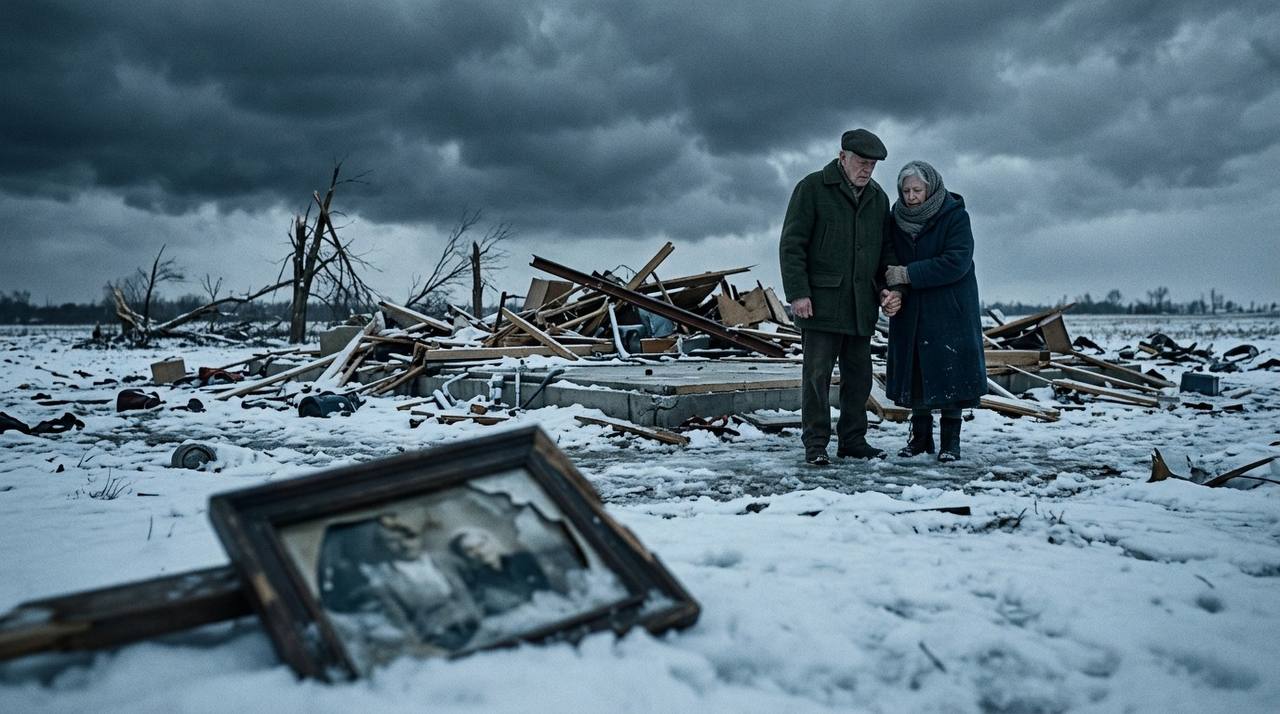
On May 17, 1978, at approximately 4:38 PM, an F4 tornado tore through the fertile farmlands surrounding Blackwood Creek, Nebraska. Its path of destruction was narrow but absolute, and among the structures obliterated was the Abernathy Homestead, a landmark farmhouse that had stood for nearly a century. When search and rescue teams arrived hours later, they found only a field of splintered timber and twisted metal, and the profound absence of the Abernathy family – Elias, his wife Martha, and their visiting granddaughter, 14-year-old Clara.
The Legacy of the Abernathy Homestead
The Abernathy Homestead was more than just a house; it was a testament to generations of perseverance. Built in 1892 by Elias Abernathy’s great-grandfather, Thomas, the two-story structure with its broad front porch and cupola had witnessed the turn of two centuries. Elias, then 68, and Martha, 65, had spent their entire lives within its orbit, caring for the land and preserving the family’s legacy. Elias had inherited the farm from his father, Samuel, in 1950, and together with Martha, they had meticulously maintained and improved the property. The house, painted a deep sage green, stood on a gentle rise, its surrounding fields stretching to the horizon. Inside, every room held the patina of decades: Martha’s meticulously kept kitchen, the living room with its worn velvet armchairs, and Elias’s study filled with ledgers and local history books. Their granddaughter, Clara, from Omaha, was spending her spring break there, a cherished annual tradition. She particularly loved the small, enclosed sun porch, where she would read for hours, oblivious to the world outside. The Abernathys were known for their quiet resilience, their deep roots in the community, and their unwavering attachment to the Homestead. Its destruction was not just the loss of property; it was the erasure of a living history.
The Storm’s Fury
The afternoon of May 17th had been deceptively calm, the air thick and humid, with an unusual stillness that local farmers recognized as a precursor to severe weather. At 4:20 PM, the first tornado warning was issued for Blackwood Creek County. Elias Abernathy, a man who trusted his senses more than any radio broadcast, had already herded Martha and Clara into the reinforced storm cellar beneath the old smokehouse, a structure they had maintained diligently. The cellar, though small, was sturdy, built into a natural depression and lined with thick stone. He had checked the latches, the emergency lamp, and ensured they had water and blankets. Elias then returned to the main house, a habit he couldn’t break—to secure what he could, to brace himself against the inevitable.
Witnesses from neighboring farms, like farmer Owen Davies, who lived two miles to the east, described the sky turning an unnatural greenish-black. The sound, he later recalled, was not merely a roar but a deep, resonant hum that vibrated through the earth, followed by an explosive shattering. The F4 tornado, a vortex estimated to be a quarter-mile wide, struck the Abernathy Homestead directly. It arrived with a violence that defied description. For a terrifying ten seconds, the venerable farmhouse was subjected to immense rotational forces and uplift, disintegrating into a maelstrom of wood, glass, and personal effects. The solid structure, which had withstood generations of prairie winds, was systematically torn apart, its components launched hundreds of feet into the surrounding fields. When the funnel cloud passed, leaving behind an eerie silence broken only by the distant wail of emergency sirens, the Abernathy Homestead was gone. In its place lay an unrecognizable debris field, acres wide, a testimony to the storm’s raw power.
Beneath the Rubble
The initial search for the Abernathys focused on the storm cellar. Owen Davies and his son, Nathan, were among the first to reach the devastated property, navigating through downed power lines and scattered wreckage. They found the smokehouse, or what remained of it, reduced to a few foundation stones. The cellar door, a heavy oak slab reinforced with iron, was nowhere to be seen, presumably ripped away by the tornado’s suction. The opening to the cellar was choked with debris – splintered beams, twisted corrugated metal, and a thick layer of mud and shattered glass. It took a full hour for the Davies men, joined by local volunteer firefighters, to clear enough of the wreckage to peer inside. What they found was a void. The cellar was empty. No Elias, no Martha, no Clara.
The discovery sent a chilling ripple through the community. How could a reinforced storm cellar, meant to be the family’s last refuge, be empty? And where were the Abernathys? The immediate assumption was that the door had been breached, or that the family had been somehow pulled out during the storm. However, a closer inspection by Sheriff Garrett Thorne two days later revealed inconsistencies. The cellar floor was largely intact, aside from some mud. There were no signs of forced entry or violent removal from within. The emergency lamp was still on its hook, unlit. The blankets were folded neatly. It was as if the Abernathys had simply walked out before the storm, or perhaps, never entered at all. But Elias had explicitly told Owen Davies he was securing them in the cellar. The mystery deepened when Thorne’s team, sifting through the pulverized remnants of the house, discovered something unexpected. Beneath where the main kitchen once stood, partially obscured by a fallen beam and buried under several feet of earth and debris, was a concrete slab. It was not part of the house’s original foundation.
The Subterranean Chamber
Excavation of the concrete slab revealed a hidden access hatch, camouflaged and reinforced. This was not a storm cellar; this was a bunker. Constructed with thick, poured concrete walls and a steel door, it appeared far more robust than any typical rural shelter. Sheriff Thorne, along with a team from the State Bureau of Investigation (SBI), supervised its careful opening on May 20th. The air inside was cool and still, smelling faintly of damp earth and ozone. The bunker was approximately ten feet by twelve feet, equipped with rudimentary bunks, a small hand-crank ventilation system, shelves stocked with canned goods, bottled water, first-aid supplies, and several battery-powered lanterns. There was even a small, self-contained composting toilet. It was clearly designed for long-term survival.
Yet, like the storm cellar, it was empty. No Abernathys. No signs of struggle, no personal items beyond the pre-stocked supplies. A closer examination by SBI forensics found no fingerprints belonging to Elias, Martha, or Clara within the bunker, only faint traces of dust and what appeared to be older, unidentifiable prints. The canned goods were dated from the early 1970s, suggesting the bunker had been built or stocked some years prior. There was a small, locked metal box on one of the shelves, which, when forced open, contained only a stack of blank paper and a single, tarnished silver locket with no engraving. The discovery of this sophisticated, hidden structure, seemingly unknown to anyone outside the immediate family, only intensified the questions surrounding the Abernathys’ disappearance. Why build such a bunker, and why was it empty when they needed it most? Initial theories suggested they had sought refuge here instead of the storm cellar, then somehow exited or were removed. But the heavy steel door, which opened inward, showed no signs of external damage or forced breach. If they had been inside, they had left voluntarily and locked it from the outside—a physical impossibility.
Lingering Questions
The official investigation concluded that Elias, Martha, and Clara Abernathy were presumed dead, their bodies likely dispersed by the tornado’s immense power, never to be recovered. The presence of the bunker was noted as an unusual detail but ultimately provided no concrete answers. Over the years, the case remained open but cold. Speculation ran rampant in Blackwood Creek. Some whispered that Elias had foreseen a different kind of disaster, perhaps an economic collapse or a global conflict, and built the bunker for that purpose, only for the tornado to intervene. Others suggested a more sinister plot: that the bunker was a pre-arranged rendezvous point for the family to vanish intentionally, escaping some unknown trouble. However, the Abernathys were respected, debt-free, and had no known enemies. There was no financial motive, no personal crisis recorded.
The land where the homestead once stood remained vacant, eventually bought by a distant relative who never built upon it, leaving the bunker sealed beneath a new layer of topsoil. The empty storm cellar was filled in. The memory of the Abernathys, and the ten seconds that erased their physical presence, continued to haunt Blackwood Creek. The community recalled Elias’s unwavering commitment to his land, Martha’s quiet strength, and Clara’s bright, youthful energy. None of it aligned with a planned disappearance or a casual abandonment of their home. The lack of any trace—not a single personal item, article of clothing, or bone—in the debris field or the surrounding miles, remained an unsettling anomaly for many. The sheer, inexplicable void they left behind was the most enduring aspect of the tragedy.
The enigma of the Abernathy family continues, interwoven with the memory of the storm. The Homestead, the symbol of their rooted existence, was gone. All that remained were fragments of their story and the silent, concrete bunker beneath the earth, a monument to an unknown purpose and a final, confounding absence.
Notes & sources
- · Story is fictional. Names, locations, and events are invented.
This story is a dramatized retelling. Some details, names, and locations have been changed or invented for narrative purposes.