On the blustery afternoon of October 17, 1998, a desolate stretch of coastline in northern California, known locally as Blackcliff Point, became the stage for a pursuit that would culminate in an enduring enigma. Federal agents, supported by K9 units and an overhead surveillance helicopter, cornered Elias Thorne, a man wanted in connection with a complex financial fraud scheme with alleged ties to foreign intelligence. With the Pacific Ocean churning three hundred feet below, Thorne faced an impossible choice.
The Weight of Accusations
Elias Thorne, 42, was not a career criminal in the traditional sense. A former data analyst for a prominent defense contractor, Aegis Dynamics, based in San Jose, his professional life had been remarkably unremarkable for nearly two decades. Colleagues described him as quiet, meticulous, and somewhat aloof, but always professional. His role involved managing sensitive financial ledgers for classified projects—contracts related to advanced aerospace development and secure communications protocols for federal agencies. It was a position of trust, requiring stringent background checks and security clearances.
The first hint of trouble surfaced in early 1998 during a routine internal audit. Discrepancies, initially small, began to appear in the accounting for Project Chimera, a high-priority, black-budget initiative. Investigations by Aegis Dynamics’ internal security, quickly joined by the Federal Bureau of Investigation, and later by elements of the Department of Defense’s Inspector General, uncovered a sophisticated embezzlement operation. Millions of dollars were systematically siphoned from these critical projects, funneled through layers of shell corporations and offshore accounts. The digital trail, painstakingly reconstructed by forensic accountants, led unequivocally to Thorne.
On August 3, 1998, federal agents arrived at Thorne’s modest suburban home in Saratoga, California, armed with a warrant for his arrest. They found the house meticulously organized but empty. Thorne had vanished without a trace, leaving behind only the ghost of a life lived with careful precision. Initial charges were for grand larceny, wire fraud, and computer fraud. However, as the scope of his alleged activities broadened, revealing potential data exfiltration and communication with undocumented foreign entities, the federal government escalated the charges to include espionage and treason. The stakes became immeasurable; Thorne was deemed not merely a flight risk but a potential national security threat. For two months, he had successfully eluded a nationwide dragnet, reportedly leveraging a network of pre-arranged safe houses, burner phones, and expertly forged identities. His movements were tracked from California to Arizona, then north again through Oregon, always a step ahead. The breakthrough came on October 16, when an anonymous tip, delivered through an encrypted channel to the FBI’s San Francisco field office, placed Thorne in a remote, off-grid cabin near the unassuming coastal town of Seabright, roughly fifty miles south of Blackcliff Point. The information was corroborated by satellite imagery and cellular triangulation data, confirming Thorne’s presence in the area. This was the break federal agencies had desperately sought.
The Net Closes
The specialized task force, composed of seasoned FBI agents, U.S. Marshals Service deputies, and tactical operators from a lesser-known federal agency specializing in fugitive apprehension, mobilized with unprecedented speed and discretion. Under the shroud of predawn darkness on October 17, they converged on the Seabright cabin. The target area was surrounded by dense redwood forests to the east and the rugged, unforgiving Pacific coastline to the west. The air was thick with the scent of damp earth and pine needles. Thorne, however, was gone. The cabin showed signs of recent occupancy – a half-eaten meal, a smoldering fire in the hearth – but its occupant had fled. Investigators theorized he had been alerted to their approach, perhaps by monitoring local emergency frequencies with a police scanner, or possibly through an unseen informant.
The perimeter was immediately expanded. K9 units, primarily German Shepherds trained for wilderness tracking, were deployed, their handlers guiding them through the underbrush. An unmarked Bell 412 helicopter, its fuselage painted a non-reflective matte black and equipped with sophisticated FLIR (Forward-Looking Infrared) technology, began an aerial sweep of the vast, challenging terrain. The area around Seabright was a labyrinth of steep canyons, winding rivers, and treacherous coastal scrubland, often giving way to sheer, unstable cliffs. It was a landscape that offered both unparalleled concealment and extreme peril. By late morning, the K9 teams had picked up Thorne’s scent, distinct and fresh, heading west, directly towards the ocean. The helicopter pilot, Captain Lena Ortiz, a former Army aviator with extensive experience in search and rescue, spotted a faint but consistent heat signature moving rapidly through a narrow, overgrown deer trail that snaked towards Blackcliff Point. This particular promontory was notorious among locals for its dramatic, windswept precipice, forming a natural dead end against the roaring Pacific. The tactical units on the ground, now numbering over two dozen personnel, accelerated their pace, attempting to cut off Thorne’s last viable escape route. The objective was clear: capture, not confrontation, especially given the sensitive nature of the intelligence Thorne might possess regarding Aegis Dynamics’ projects and his potential foreign contacts. The wind, now gusting strongly inland, carried the sharp scent of salt and eucalyptus, as the net tightened inexorably around the elusive fugitive. The sound of waves crashing against distant rocks grew louder with every step.
The Ultimate Escape
At approximately 1:47 PM, Elias Thorne reached the very edge of Blackcliff Point. The promontory extended sharply into the Pacific, a formidable granite and basalt wall that plunged three hundred feet into the churning ocean below. The base of the cliff was a chaotic maelstrom of white water and jagged, obsidian-like rocks, perpetually obscured by a fine, cold mist. Locals had long ago christened this spot “the Drowned Man’s Maw,” a testament to its unforgiving nature. Thorne stood there, a solitary, gaunt figure silhouetted against the tumultuous gray sky, his windbreaker flapping violently around him.
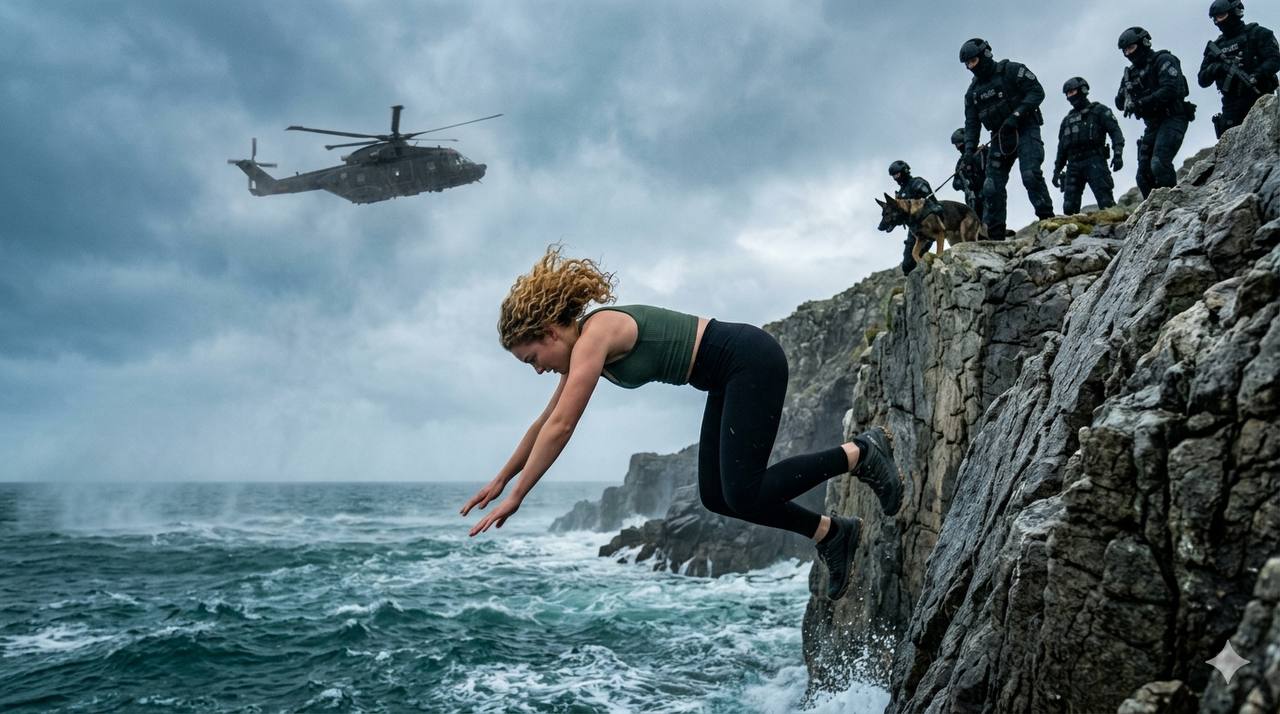
From the gnarled cypress trees behind him, the tactical units emerged. Their approach had been swift and silent, but the final meters were exposed. Weapons were held at the low-ready position, but no shots were fired. Above, the dark Bell 412 helicopter hovered directly overhead, its powerful rotors beating the air into a deafening, disorienting thrum. The downwash created a vortex of wind and spray, effectively pinning Thorne against the precipice. K9 handlers struggled to restrain their barking German Shepherds, their leashes taut against the dogs’ straining bodies. Special Agent Marcus Hayes, a veteran FBI negotiator leading the ground team, raised a bullhorn to his lips. “Thorne! This is your only chance. Drop to your knees, hands behind your head. No harm will come to you. We need to talk.”
Thorne slowly turned to face his pursuers. His face was gaunt, unshaven, and etched with exhaustion, but his eyes, even from a distance, appeared lucid and resolute. He offered no reply, no plea, no defiance. He scanned the faces of the agents below, then looked up at the menacing silhouette of the helicopter. For a long moment, perhaps five seconds, he stood perfectly still, absorbing the scene. The wind whipped his dark, unkempt hair across his face. Then, with a deliberate, almost serene motion, he took a deep breath. Without a word, without a backward glance, he took a single, decisive step off the edge. His body, once a distinct figure, plummeted in silence, swallowed instantly by the vast, roaring expanse of the ocean. The collective gasp from the agents on the cliff edge was lost in the wind and the helicopter’s roar.
Search and Scrutiny
The immediate reaction from the federal agents was a blend of shock and disciplined, albeit frantic, response. Agent Hayes, his voice strained, immediately ordered a full search and rescue operation. The helicopter, which had witnessed the entire, horrifying leap, descended cautiously, its powerful searchlight cutting through the sea spray and illuminating the roiling water directly below the cliff. The U.S. Coast Guard was notified within minutes, dispatching a rescue cutter, the USCG Barracuda, and specialized divers to the area from its nearby station in Monterey.
For the next 72 hours, the treacherous waters around Blackcliff Point were scoured with unrelenting intensity. The currents in that particular region were notoriously strong and unpredictable, known for their ability to pull debris and bodies far offshore or trap them in the labyrinthine submerged caves and rock formations that riddled the coastline. Divers, braving the frigid, dark waters, reported extreme conditions: powerful undertows that threatened to tear their equipment, limited visibility due to the perpetual churn and murkiness, and the constant danger of being dashed against the jagged underwater landscape. Specialized sonar equipment was deployed, sweeping the seabed for any sign of a body or personal effects. Despite the extensive, multi-agency efforts—involving not just the Coast Guard but also local sheriff’s department marine units and volunteer search parties—no trace of Elias Thorne was found. No body, no clothing, no personal effects, not even a single shoe. It was as if the ocean had simply swallowed him whole, leaving no ripple.
The official report, compiled by the lead FBI investigator, concluded that Thorne had likely perished in the fall, suffering catastrophic injuries upon impact with the water or rocks, and subsequently been swept out to sea, his body irretrievably lost to the powerful currents. The extreme conditions, the report emphasized, made recovery virtually impossible. Privately, however, some agents harbored gnawing doubts. The calculated nature of Thorne’s leap, his history of meticulous planning and evasion, and the sheer audacity of the act, coupled with the complete absence of any physical evidence, fueled persistent speculation. Could he have survived such a fall? Was this a desperate act of suicide, the final, tragic surrender of a cornered man, or was it a meticulously planned final escape, a theatrical vanishing designed to throw off his pursuers and facilitate a deeper disappearance? The questions lingered, unspoken in official reports but persistent in the minds of those who witnessed the event.
The Unseen Depths
In the months that followed, the case of Elias Thorne, despite its official closure, remained open in an unofficial capacity, growing increasingly cold. The financial fraud scheme he was implicated in was partially untangled, revealing a complex web of shell corporations, international wire transfers, and offshore accounts spanning multiple continents. Millions of dollars—estimates ranged from $15 to $20 million—remained unaccounted for, vanished into the digital ether. The alleged foreign intelligence connection, whispered about in hushed tones within federal circles, was never definitively proven, nor could it be entirely disproven. Without Thorne, the full extent of the operation, his role within it—whether he was a mastermind, a willing participant, or merely a highly skilled but manipulated pawn—could not be determined. Critical questions about data exfiltration and the compromise of Aegis Dynamics’ sensitive projects hung unresolved.
The federal task force, its mission incomplete, was eventually disbanded, its members reassigned to other high-priority cases. Blackcliff Point, once a serene but dangerous natural landmark, became irrevocably synonymous with Thorne’s vanishing. For years afterward, locals and passing hikers would sometimes report seeing unidentifiable debris wash ashore, or hearing strange, mournful sounds carried on the wind—sounds they imagined might be connected to the man who jumped. But nothing ever linked concretely back to Elias Thorne.
Theorists, both amateur and professional, began to posit alternative explanations. Some suggested that Thorne might have been a highly trained operative, possibly with a background unknown even to his colleagues at Aegis Dynamics, capable of surviving such a fall through specialized training or equipment, perhaps with an underwater escape vehicle or a pre-positioned rendezvous point. They pointed to the sheer lack of evidence as proof of a sophisticated plan, rather than a catastrophic accident. Others entertained a more sinister outcome: that Thorne was indeed silenced, not by the fall, but by hidden actors who ensured his permanent disappearance before he could be captured and interrogated. This theory often linked back to the shadowy foreign powers he was suspected of aiding. A more audacious hypothesis suggested that the “leap” itself was a staged event, a carefully orchestrated performance designed to facilitate his disappearance into a new identity, courtesy of the very same entities he was accused of betraying his country for.
The truth of Elias Thorne’s fate remains submerged, much like the secrets he may have carried from Aegis Dynamics. The official narrative points to a desperate man meeting a watery, unforgiving end, yet the complete absence of any physical evidence, coupled with the persistent whispers of a larger conspiracy, ensures that the mystery of Blackcliff Point endures. The wind still whips across the cliff face, the waves still crash against the rocks below, and the question of what truly happened to Elias Thorne hangs perpetually in the salty air, unanswered.
Notes & sources
- · Story is fictional. Names, locations, and events are invented.
This story is a dramatized retelling. Some details, names, and locations have been changed or invented for narrative purposes.