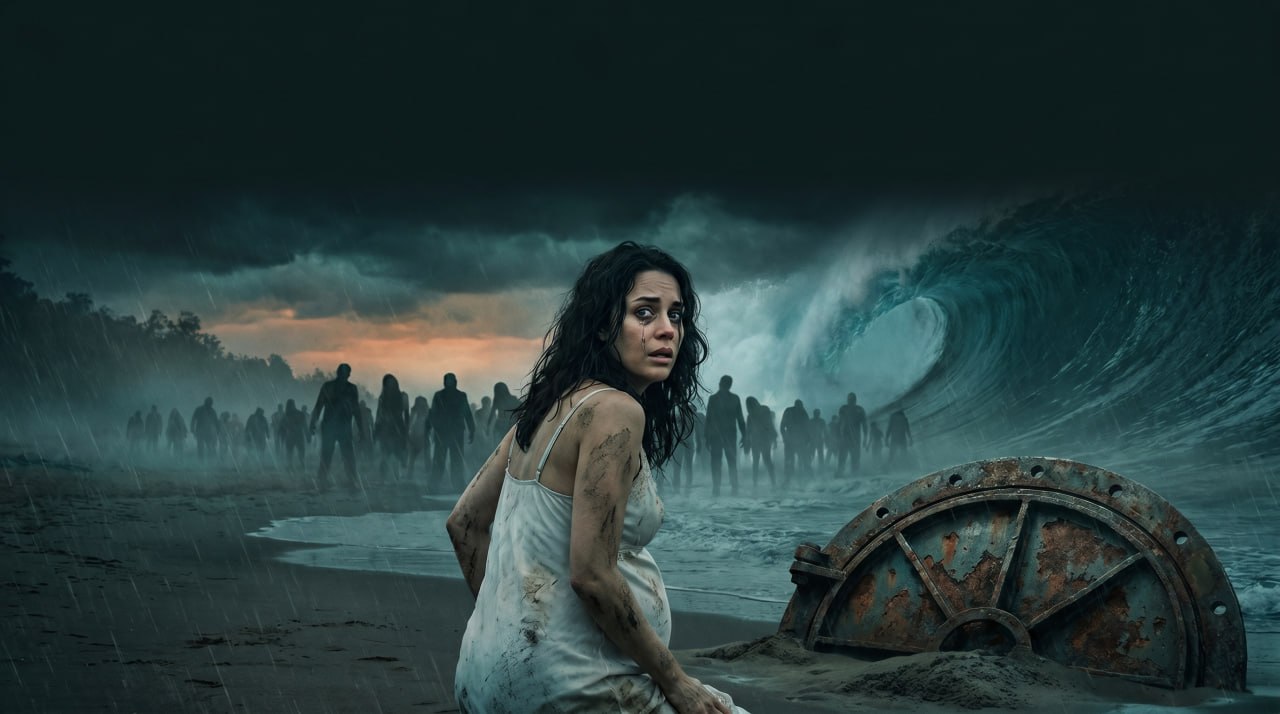
The rain had begun again, a cold, insistent drizzle that plastered Eleanor Vance’s damp hair to her forehead. She was moving with a deliberate, agonizing slowness, her advanced pregnancy a constant, heavy reminder of the clock ticking inside her. Behind her, the distant, guttural moans of the infected horde grew louder, but it was the rising tide, a dark, churning menace on the horizon, that truly commanded her attention. Her focus remained fixed on a point ahead, a cluster of dilapidated structures that once formed the outskirts of Port Blossom. Beneath one of them, nestled in the damp earth, was a concrete bunker. Inside, her five-year-old son, Leo, waited. He was alone, relying on the emergency rations and the air filtration system she had meticulously installed months before the world had fractured. The filtration unit, however, required a specific ceramic membrane, a component she had foolishly left at their old, now overrun, home. Now, with the tsunami warning blaring hours too late and the infected closing in, her return was not a matter of choice, but of an absolute, primal imperative.
The Erratic Descent
Eleanor remembered the initial reports of the outbreak with a detached clarity. They had been vague, easily dismissed by official channels as localized incidents. By the time the first infected had shambled into Port Blossom, the town’s defenses were nonexistent. Her husband, Arthur, had been away on a supply run, a trip from which he never returned. Eleanor, already several months pregnant, made the decision to convert their old root cellar into a fortified bunker, a project Arthur had always planned but never executed. It was a crude, hastily reinforced space, but it offered protection from the initial chaos. They had survived the first months there, rationing food and water, listening to the world outside dissolve into a cacophony of screams and silence. Leo, remarkably resilient, had adapted to the confined space, comforted by his mother’s presence and a worn copy of The Little Prince.
Three days prior, the air filtration system had begun to sputter. The air, already stale, started to carry a faint, metallic tang. Eleanor knew the ceramic membrane, designed to filter out airborne pathogens and dust, was failing. She had a spare, she thought, in a sealed medical kit at their previous house, a modest two-story bungalow just a mile from their current bunker location. The decision to leave Leo alone, even for a few hours, had been agonizing. She had explained it simply: “Mommy needs to get something important to make sure we can breathe, sweet pea. You stay here, don’t open the door for anyone. I’ll be back before the sun sets.” He had nodded, his small face serious, clutching his book. What she hadn’t accounted for was the sudden, late-season hurricane system that had intensified into a rogue tsunami, nor the resurgence of the infected in the once-cleared coastal zone. The initial trek had been difficult but successful. Retrieving the membrane had been complicated by a small cluster of infected in the house. Now, the return journey was an entirely different proposition.
The Rising Waters and the Dead
The landscape of Port Blossom had transformed since Eleanor had last seen it. What remained of the main street was now partially submerged, a murky, debris-strewn channel where cars floated like forgotten toys. The wind, which had been a distant murmur, now howled, carrying the scent of salt and decay. The first explicit wave of the tsunami had already struck the outer harbor, pushing a wall of water inland. It had receded partially, leaving behind a fresh layer of silt and a chilling silence, occasionally broken by the creak of collapsing structures. The second, larger wave was still hours away, but the water level was steadily rising, inch by agonizing inch.
Eleanor navigated the flooded streets, her heavy boots splashing through cold water that reached her shins. She kept to the higher ground where possible, favoring the narrow alleys between the skeletal remains of buildings. The infected, drawn by sound or simply shambling aimlessly, were a constant threat. Their movements were slower in the water, their decaying bodies buoyed by the current, but their numbers were still formidable. She clutched a scavenged crowbar, its cold metal a familiar weight in her hand. Her mind was a singular tunnel: Leo. Every painful step, every strained breath, was for him. She could feel the baby shifting within her, a quiet, internal confirmation of life amidst the encroaching desolation. The irony was stark: one life pushing outwards, while another, her firstborn, waited in a tomb-like refuge, dependent on her desperate, dangerous path.
Through the Crumbling Town
The path to the bunker became increasingly perilous. A section of the old town hall, already gutted by fire, finally succumbed to the water pressure, its remaining brick facade crumbling into the street with a thunderous crash. The sound echoed, momentarily drowning out the distant roars of the infected. Eleanor pressed herself against a ruined storefront, waiting for the debris to settle, her heart pounding against her ribs. She noted a small group of infected, perhaps six or seven, turning their slack faces towards the noise, their progress momentarily halted by the chaos. This offered a brief window of opportunity. She moved quickly, her heavy frame surprisingly agile under the immense pressure, darting across the newly cleared path before they could reorient themselves.
The air was thick with the smell of brine, wet earth, and something metallic, perhaps from the ruptured fuel lines of abandoned vehicles. The sky, a bruised purple, mirrored the churning grey of the sea. She could see the main road now, a wider, more exposed stretch that led directly to the small wooded area where the bunker was concealed. It was a calculated risk. Staying in the alleys offered cover, but the water was deeper, the debris more treacherous. The open road meant exposure, but potentially faster progress. She chose the road, her eyes scanning for movement, her ears attuned to the specific, dragging shuffle of the infected. She passed a child’s bicycle, half-submerged, its front wheel slowly spinning in the current, a poignant, silent testament to the lives lost here. The silence, punctuated only by the wind and the distant cries, felt heavier than any noise.
The Wave’s Embrace and the Bunker’s Edge
The first true surge of the second wave hit as Eleanor reached the edge of the wooded path leading to the bunker. It wasn’t a towering wall, but a rapid, powerful rise of the existing water, an almost instantaneous flood that transformed the street into a raging river. She was knocked off her feet, the crowbar slipping from her grasp. The cold water enveloped her, dragging her against a broken lamppost. Panic, a cold, sharp claw, threatened to overwhelm her. She fought it, focusing on Leo, on the need to breathe, to keep moving. With a surge of adrenaline, she pushed off the lamppost, kicking and clawing her way through the torrent, towards the slightly higher ground of the bunker’s entrance, now barely visible through the spray and rain.
The surge receded as quickly as it had arrived, leaving her gasping, soaked, and battered, but closer. The bunker’s camouflaged entrance, a reinforced steel hatch disguised beneath a mound of earth and dead foliage, was now only a few feet from the water’s edge. The air around it seemed to shimmer, a trick of the light or her exhaustion. She scrambled on hands and knees towards it, the ceramic membrane still clutched tightly in her hand. The infected, caught in the same surge, were now scattered, some pinned against debris, others slowly righting themselves, their moans more desperate. She ignored them, her focus entirely on the heavy hatch, the simple combination lock Arthur had installed, the lifeline to her son. Her fingers, numb with cold and exertion, fumbled with the dial, each turn an exercise in excruciating precision.
Desperation at the Door
The combination clicked. The heavy bar of the lock retracted with a sound that seemed deafening in the storm. Eleanor grasped the cold, rusty handle, her muscles screaming in protest as she heaved upwards. The hatch, stiff with disuse and the weight of the water, groaned, resisting her efforts. A surge of frustration, hot and bitter, mixed with her exhaustion. She pushed again, gritting her teeth, picturing Leo’s face, his wide, trusting eyes. The wood and earth camouflage splintered, and the hatch lifted a few grudging inches, revealing the dark, concrete descent into the bunker. The air from inside, stale but breathable, offered a faint, reassuring whisper.
But the water was rising again, not from another large wave, but from the slow, relentless creep of the tide. It was already lapping at the edge of the bunker’s opening, threatening to pour in. Behind her, the sounds of the infected were closer, some having regained their footing, their shuffling steps audible over the roar of the wind. She could not wait. She had to get inside, seal the hatch, and reach Leo. With one final, desperate push, she forced the hatch open just wide enough to slip through, her body scraping against the rough concrete. The ceramic membrane, her mission, was still secure in her hand. As she descended into the darkness, the sounds of the storm and the approaching horde seemed to amplify for a brief, terrifying moment before she began to pull the heavy hatch shut above her, the water already pooling around her feet.
Notes & sources
- · Story is fictional. Names, locations, and events are invented.
This story is a dramatized retelling. Some details, names, and locations have been changed or invented for narrative purposes.