On January 17, 1998, Elias Thorne, a man recently estranged from his life in the coastal town of Seabrook, disappeared into the forbidding expanse of the Whispering Peaks Forest. His last known movements placed him near the logging road that snaked towards the perpetually snow-covered upper elevations, a region local to the remote settlement of Oakhaven knew to avoid. Thorne, a former financial consultant facing allegations of embezzlement, was not seeking solitude, but rather an escape route. What he found instead, deep within the ancient, frost-choked woods, was a place of impossible shelter, and a presence that defied natural explanation.
The Relentless Cold and the Pursuit of Oblivion
Elias Thorne had driven his battered sedan as far as the snow allowed, abandoning it near the frozen tributary of the Eldoria River. His intention was unclear even to himself: perhaps to cross the border into the next state, perhaps simply to vanish. He carried a rucksack with minimal supplies—a heavy wool blanket, a small hatchet, dried jerky, and a compass he barely knew how to use. The initial days were a blur of movement, driven by a primal fear of apprehension and the encroaching cold. Temperatures in the Whispering Peaks often plummeted to dangerous lows, even in early spring, and the persistent snowpack, a geological anomaly, rendered the landscape an unrelenting monochrome.
He walked for three days, his boots sinking into drifts that sometimes reached his waist. The air was thin, biting, and each breath a shallow ache in his lungs. The forest was an oppressive cathedral of ancient firs and spruces, their branches heavy with rime, their needles a muted dark green against the stark white. The silence was profound, broken only by the crunch of his own footsteps, the distant, mournful howl of a wolf pack that seemed to track his progress, or the occasional sharp crack of ice shifting on unseen waterways. Elias, unused to such rigorous conditions, began to succumb. His fingers and toes were numb, his vision blurred by exhaustion and hunger. He rationed his jerky, but it was insufficient. He knew, with a certainty that settled deep into his bones, that he was dying. His escape had become a slow, freezing descent into oblivion.
On the fourth day, a blizzard descended, a whiteout that reduced visibility to mere feet. Disoriented, his internal compass failing, Elias stumbled through the swirling snow, his body trembling uncontrollably. He fell repeatedly, the impact jarring his already aching joints. He thought of his wife, Clara, and the life he had so carelessly dismantled. Regret, however, was a luxury his failing mind could no longer afford. Survival, raw and desperate, was his only remaining instinct. It was in this state of near-hypothermia, his lungs burning, his eyelids heavy with frost, that he saw it.
The Impossible Door
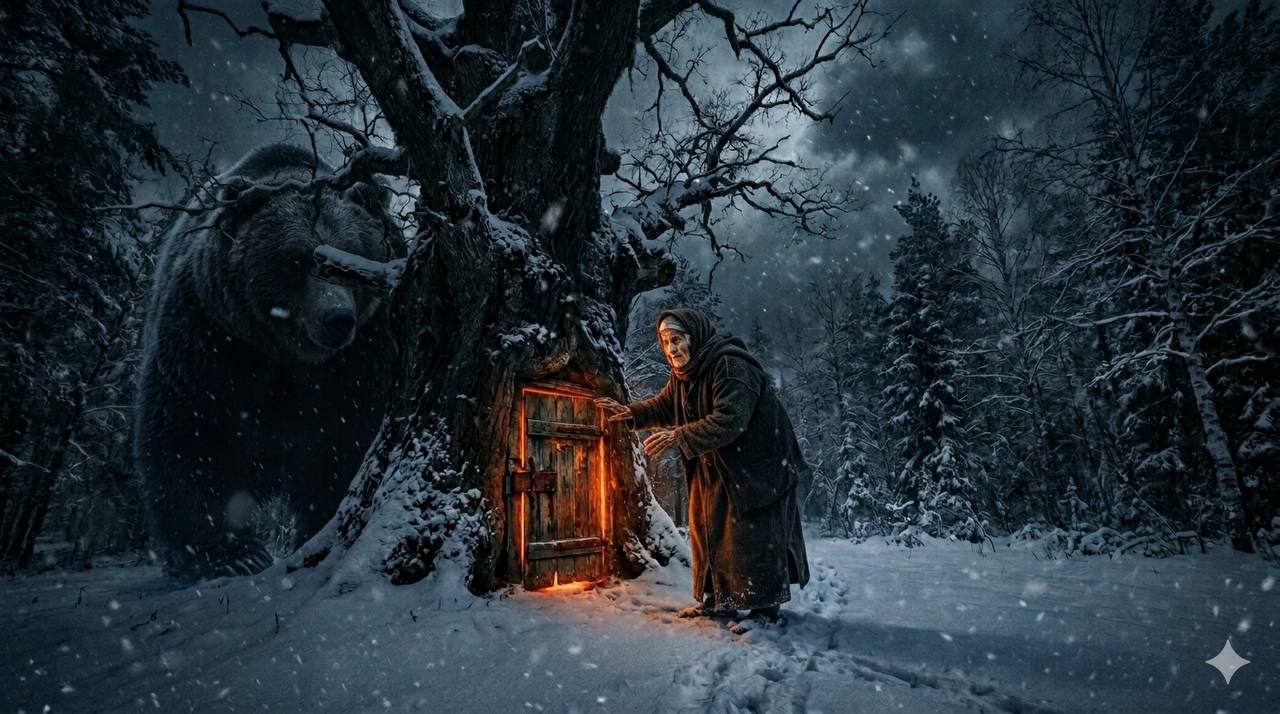
Through the swirling white curtain of the blizzard, a silhouette emerged, massive and dark against the snow. It was a tree, but unlike any Elias had ever seen. Its trunk was of an improbable girth, easily forty feet in diameter, a colossal monument of deeply fissured bark, gnarled and twisted as if shaped by millennia of wind and ice. Its upper canopy was lost in the storm, but even from his vantage point, Elias perceived its immense, ancient presence. What truly arrested his attention, however, was not the tree’s impossible scale, but something embedded within its base.
Nestled directly into the bark, about seven feet from the snow-covered ground, was a door. It was made of dark, heavy wood, carved with simple, weathered patterns that resembled intertwining roots or abstract symbols. A brass knocker, tarnished green with age, hung conspicuously from its center. The sight was an affront to reason. A door, in the heart of the perpetually frozen Whispering Peaks Forest, miles from any known human settlement, in the trunk of a tree that seemed to belong to a bygone geological era.
For a moment, Elias hesitated. Logic screamed at him to dismiss it as a hallucination, a cruel trick of his failing mind. But the cold was real, the gnawing hunger was real, and the certainty of his imminent death was undeniably real. What was the risk of investigating a mirage when the alternative was certain demise? He stumbled forward, driven by a desperate, irrational hope. He reached the base of the tree, its bark rough and cold beneath his gloved hand. The snow here seemed thinner, almost as if the colossal trunk radiated a subtle, imperceptible warmth. He struggled to reach the knocker, his body weak. With a final surge of effort, he raised his arm and let the heavy brass fall.
The sound was dull, muffled by the thick wood, but distinct in the suffocating silence of the blizzard. He waited, shivering, leaning against the ancient bark. Moments stretched into an eternity. He was about to turn away, to accept his fate in the snow, when a soft click echoed from within. The door, without a creak or groan, slowly opened inward, revealing a sliver of dimly lit warmth.
Within the Sentinel’s Embrace
Standing in the aperture was a woman. She was old, undeniably so, but her age was difficult to place. Her face was a network of fine lines, her eyes a startling, clear blue that seemed to hold the cold light of the forest itself. Her hair, the color of spun moonlight, was pulled back in a simple braid. She wore a simple, undyed wool dress, surprisingly clean given the environment. She did not speak, but merely looked at Elias, her gaze unwavering, devoid of surprise or pity.
“Please,” Elias croaked, his voice raw, “I’m lost. Dying.”
The woman nodded once, a slow, deliberate movement. She stepped back, opening the door wider. Elias stumbled across the threshold, collapsing onto a floor of smooth, polished wood. The air inside was warm, dry, and carried the faint scent of pine needles and something else, something earthy and ancient, like moss and forgotten stone. The interior was a single, circular chamber, surprisingly spacious, its walls formed by the living wood of the tree trunk itself. Smoothly carved shelves held ceramic bowls and bundles of dried herbs. A small, smokeless fire burned in a hearth made of dark, river stones, casting dancing shadows across the room.
The woman closed the door with the same silent efficiency. She knelt beside Elias, her movements fluid and unhurried. She offered him a small, clay cup filled with a hot, clear broth that tasted faintly of mushrooms and forest herbs. Elias drank greedily, the warmth spreading through his frozen limbs. He expected questions, suspicion, but there were none. The woman merely watched him with those ancient, placid eyes. He noticed that the room, despite its rustic appearance, had no visible windows, no obvious source of light beyond the small hearth fire and a few glowing, orb-like fungi placed in niches along the walls. The silence within the tree was absolute, a profound quiet that seemed to absorb all external sound. The blizzard outside might as well have been a world away.
The Unspoken Terms of Sanctuary
Elias Thorne spent the next several days recovering within the ancient tree. The woman, whom he never heard referred to by name, provided him with simple, nourishing meals: more broth, dried berries, and a dense, dark bread. She spoke rarely, and when she did, her words were simple, declarative sentences, often related to his physical needs or the weather outside. He tried to ask about her, about the tree, about how she came to live in such a place, but his questions were met with a calm, unblinking stare that discouraged further inquiry. It was not hostile, but rather like questioning a natural phenomenon.
He observed her. She moved with an economy of motion, tending to the fire, preparing meals, or simply sitting in quiet contemplation. She never seemed to sleep in the conventional sense, though he sometimes found her in a trance-like state, her eyes open but unfocused, seemingly communing with the very structure of the tree. There were no books, no distractions, only the steady rhythm of existence within the wooden walls. Elias, initially grateful for the sanctuary, slowly began to feel a creeping unease. The warmth was comforting, the food sustenance, but the absolute silence and the woman’s inscrutable presence began to weigh on him. He felt as though he was being observed, not judged, but measured, understood in a way that transcended human interaction.
He noticed subtle, disquieting details. The glowing fungi in the niches seemed to pulse with a faint, internal light, sometimes shifting their hues. The carved patterns on the door, and indeed subtly etched into the wooden walls, occasionally appeared to move, the intertwining lines seeming to writhe just at the edge of his peripheral vision. He would blink, and they would return to static patterns. He tried to open the door once, out of curiosity, but found it unyielding, as if the wood had somehow fused back together. The woman, without turning, had simply said, “Not yet.”
The Unseen Exchange
The passage of time inside the tree became fluid, indistinct. Elias lost track of days. The sense of urgency he’d felt about his past—the embezzlement, the pursuit—began to recede, replaced by a profound, almost hypnotic calm. This calm, however, was not peaceful. It felt imposed, a state of being dictated by the tree itself, or perhaps by its ancient inhabitant. He found himself spending hours simply staring at the patterns on the walls, feeling a strange resonance, a connection to the deep, silent life of the forest around them.
The woman seemed to know his thoughts before he articulated them. Once, he pondered aloud about his family, a rare breach of the internal quiet he had adopted. She looked at him, those clear blue eyes unreadable, and said, “They are well. They remember you differently now.” He did not press her for clarification, but the words settled heavily in his mind. What did “differently now” mean? Had time passed differently outside? Had his memory been altered, or theirs?
He started to feel lighter, not just physically, but as if a burden had been lifted. Yet, simultaneously, a sense of his own identity began to erode. Who was Elias Thorne, the financial consultant? The fugitive? The man who had stumbled into a tree? These labels seemed increasingly irrelevant, distant echoes from a life that felt like a dream. The tree, the woman, the perpetual silence—they were becoming his reality. He ate the simple meals, sat by the hearth, and listened to the profound quiet, feeling his own essence slowly being absorbed into the ancient rhythms of the place. He was no longer trying to escape death; he was simply existing, a part of the sentinel’s embrace. The “living nightmare” was not one of terror, but of a slow, insidious dissolution of self.
The Return to the White Silence
One indeterminate morning, the woman approached him. She did not speak, but extended her hand. In it rested a small, smooth river stone, cool and grey. Elias took it. Then, with the same silent deliberation as when he had first arrived, she walked to the door and opened it.
The blizzard had subsided. The forest outside was pristine, blanketed in an impossibly deep layer of fresh snow. The air was crisp, clean, and utterly still. The sun, a pale disc in the distant sky, cast long, blue shadows across the landscape. Elias stepped out, feeling a faint tremor in his legs. He turned back to look at the woman, still standing in the doorway of the ancient tree. Her expression was unchanged.
He looked down at his hands. They were no longer scarred by frostbite. His skin was smooth, unblemished. He felt no hunger, no cold. The weight of his rucksack was gone, or perhaps he had left it inside. He felt a profound sense of lightness, an absence of the fear and desperation that had driven him into the woods. He looked back at the woman, but she was already beginning to close the door.
He turned and walked, effortlessly, through the deep snow. The trees seemed to part for him, the forest floor firm beneath his steps. He did not know where he was going, or why. The river stone in his hand felt strangely warm now. He had sought refuge from death, and had found it, but the terms of that refuge remained unspoken, and the nature of his transformation, unknown. The Whispering Peaks Forest stretched out before him, vast and silent, as he walked deeper into its white embrace, a man reborn, or perhaps, simply repurposed. He was no longer Elias Thorne, the fugitive. He was something else, and the forest, ancient and indifferent, held his secret, as it had held many others.
Notes & sources
- · Story is fictional. Names, locations, and events are invented.
This story is a dramatized retelling. Some details, names, and locations have been changed or invented for narrative purposes.