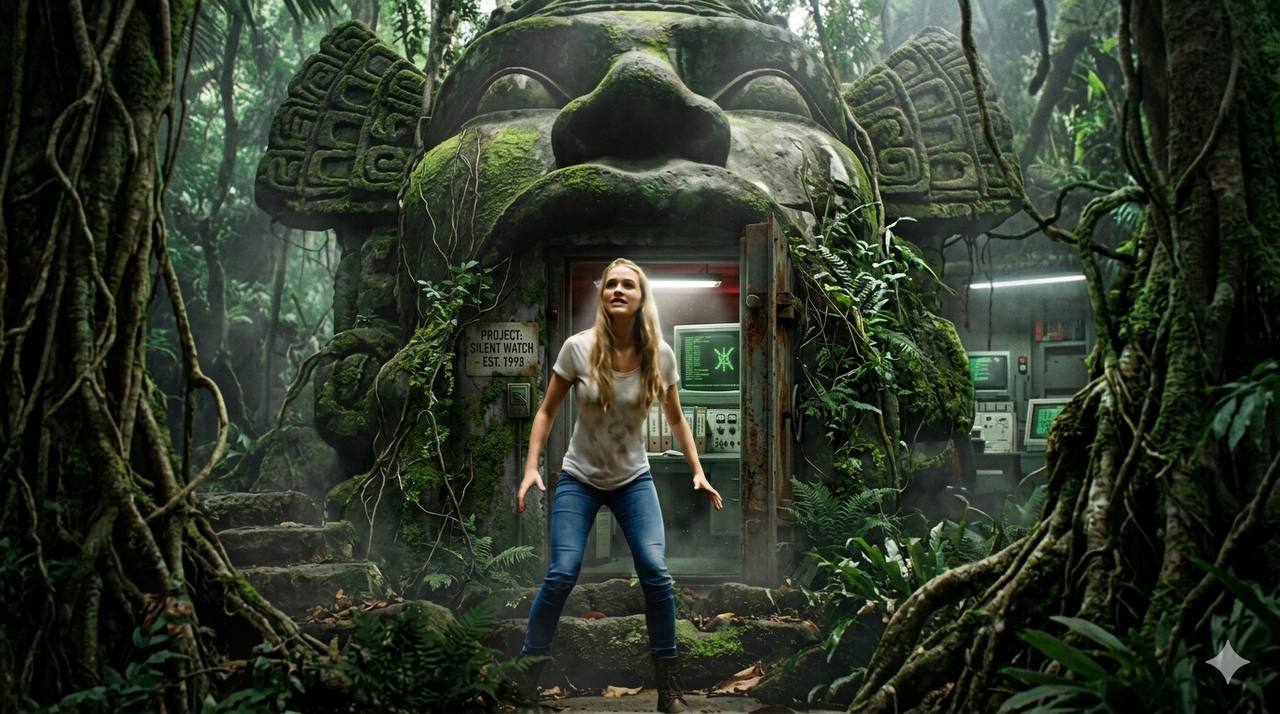
On October 17, 2018, Sara Maxwell, a freelance ecological researcher, located the perimeter of what was once known as Project Silent Watch. Situated deep within the dense, mist-shrouded Blackwood Forest, approximately thirty miles inland from the coastal town of Oakhaven, Oregon, the facility had been abandoned for decades. Its entrance, a heavy steel door set into a concrete structure half-swallowed by moss and tangled roots, felt less like an archaeological find and more like the mouth of something dormant, yet aware.
The Whispers of Oakhaven
The Blackwood Forest had always been a place of local lore. Generations of Oakhaven residents spoke of an unnatural stillness that sometimes settled over certain clearings, or a feeling of being watched from the depths of the trees, even when no wildlife was visible. These were typically dismissed as the fanciful musings of a community isolated by geography and an abundance of old growth. However, a pattern of unexplained disappearances dating back to the late 1980s had begun to lend a darker undertone to the anecdotes. Hikers, campers, and even a few local hunters had vanished without a trace, leaving behind only their vehicles or campsites. Authorities had attributed these incidents to the inherent dangers of the vast, unforgiving wilderness, but the lack of bodies or even significant evidence troubled many.
Sara Maxwell had initially come to the region researching anomalous ecological patterns, particularly the unusual biodiversity observed in certain microclimates within Blackwood. Her interest in Project Silent Watch was serendipitous, sparked by a cryptic reference in a declassified government document she had accessed through an obscure academic archive. The document, dated 1987, mentioned a highly sensitive, experimental research initiative aimed at advanced bio-acoustic and environmental monitoring within a designated ‘anomalous zone’ of the Oregon coast range. The project was abruptly defunded and sealed in 1991, with all personnel reassigned and records flagged as ‘restricted access.’ The official reason cited was budget reallocation, but the tone of the final memorandum suggested a more urgent, unspoken closure.
Unearthing Silent Watch
Accessing the facility proved challenging. The steel door, rusted and sealed by years of neglect, required specialized tools and several hours of effort. When it finally groaned open, it revealed a short, concrete tunnel leading into darkness. The air inside was heavy, cool, and still, carrying the faint metallic scent of old machinery and the earthy smell of deep forest decay. Sara’s headlamp cut through the oppressive gloom, illuminating a series of interconnected chambers. The walls were lined with sound-dampening panels, peeling and stained. Desks were overturned, chairs scattered, and equipment racks stood empty, save for a few stray cables and rusted bolts. It was a scene of sudden, rather than gradual, abandonment.
In the central control room, a bank of monitors, ancient CRT screens, sat dormant. Their glass faces reflected Sara’s headlamp beam, an unsettling array of silent, unblinking eyes. A large, faded schematic on one wall depicted a complex network of sensors extending outwards, deep into the surrounding forest. Labels indicated sophisticated microphones, infrared cameras, seismic sensors, and chemical sniffers. The project’s scope, even in its decaying state, was impressive, far exceeding conventional environmental research of its era. A single, heavily corroded plaque above a main console read, in stark, block letters: “PROJECT: SILENT WATCH. Observing the Unseen. Understanding the Unspoken.”
The Archives and the Anomaly
Behind a locked, reinforced door in a smaller adjacent room, Sara discovered the project archives. Shelves of moldering binders and stacks of magnetic tapes, surprisingly well-preserved in the dry, cold environment, contained decades of raw data. The logs, meticulously kept, detailed daily environmental readings, animal vocalizations, and seismic activity from the designated ‘anomalous zone.’ For weeks, Sara returned to the facility, meticulously digitizing and analyzing the information.
Her initial analysis confirmed the project’s stated goal: comprehensive monitoring. However, as she delved deeper, anomalies began to emerge. Starting in late 1989, the data logs showed increasingly frequent and inexplicable spikes in activity. Bio-acoustic sensors registered complex, non-animal vocalizations – rhythmic pulses, deep thrums, and high-frequency chimes – that did not correspond to any known species or natural phenomena. These events were often accompanied by localized seismic tremors too subtle to be detected by standard geological surveys, but consistently registered by Silent Watch’s sensitive network. Furthermore, infrared cameras, initially designed to track nocturnal wildlife, began to capture fleeting, indistinct thermal signatures that moved with an unusual intelligence, often appearing to circumnavigate sensor fields rather than blindly crossing them.
The project lead, a Dr. Alistair Finch, grew increasingly agitated in his personal notes, interleaved within the official reports. His entries shifted from scientific detachment to a tone of growing concern, then alarm. He wrote of “unstructured intelligence,” “adaptive patterns,” and, in one entry from July 1990, “the forest is learning to see us through our own eyes.” The final entry, dated August 12, 1991, simply stated: “They know. We must cease observation immediately. Containment is no longer possible. Failsafe initiated. Evacuate.”
Echoes in the Dark
As Sara worked through the archives, the facility itself seemed to respond. On several occasions, as she reviewed Finch’s increasingly desperate notes, a faint, high-pitched whine would emanate from the dormant computer systems, flickering erratically before dying down. One evening, deep within the control room, a single, ancient CRT monitor on the main console suddenly sputtered to life. Its screen displayed a static-filled image of dense forest foliage, swaying gently. For a moment, a barely perceptible ripple, like something moving just beneath the surface of the image, passed across the screen before it dissolved back into darkness with a soft pop.
These occurrences were unsettling, but Sara, rational by nature, attributed them to decaying electronics and her own heightened awareness in the isolated environment. She logged each instance, maintaining her detached, scientific approach. However, the feeling of being observed, a sensation she had initially dismissed as a product of the facility’s history, grew more pervasive. It was not a human presence, but something more elemental, a pervasive awareness that seemed to seep from the very walls and foundations of Project Silent Watch. When she ventured outside for breaks, the silence of the Blackwood Forest felt heavier, the shadows deeper, and the rustling leaves seemed to carry a deliberateness that belied mere wind.
The Overgrowth and the Oversight
Dr. Finch’s cryptic final notes suggested a deliberate shutdown, a ‘failsafe.’ Sara found evidence of this in the facility’s power systems – emergency protocols designed to sever external connections and isolate the site. Yet, the question remained: isolate it from what? Or, perhaps more disturbingly, isolate what within it? The ‘unstructured intelligence’ Finch referred to, the ‘adaptive patterns,’ seemed to imply an entity or phenomenon that reacted to observation, that learned from being watched. The project, intended to monitor the environment, may have inadvertently provoked it.
The jungle opening its eyes, as the legend foretold, was not a violent, destructive act. It was a subtle shift, a quiet awakening. The monitors flickering to life were not merely malfunctioning equipment; they were conduits, brief windows into a consciousness that had been stirred by the intrusive gaze of Project Silent Watch. Finch’s team had sought to understand the unseen and the unspoken. In doing so, they had brought it into focus, and in turn, it had begun to focus on them.
Sara eventually packed her equipment, leaving the heavy steel door ajar. The data she had collected was extensive, enough for years of analysis. She knew the answers would not come easily, if at all. The silence of the Blackwood Forest remained, but now, to her, it felt less like an absence of sound and more like a held breath. The dense canopy, once merely a mass of leaves and branches, seemed to possess a depth, a quiet vigilance, that had not been there before.
Notes & sources
- · Story is fictional. Names, locations, and events are invented.
This story is a dramatized retelling. Some details, names, and locations have been changed or invented for narrative purposes.