On July 14, 2017, the last known communication from Elias Thorne, a reclusive former systems architect, was an automated financial transfer to a local utility company, settling his final bill. Three days later, a concerned neighbor, Martha Finch, reported a peculiar silence emanating from Thorne’s 80-acre property nestled deep within the Copper Creek wilderness of northern Idaho. Thorne, known for his rigorous routine and near-total self-sufficiency, had not collected his mail in a week, nor had his usual evening generator hum been heard. By July 20, local deputies from the Clearwater County Sheriff’s Office were preparing to execute a welfare check on the man who had, for all intents and purposes, built a fortress to disappear within.
The Architect of Solitude
Elias Thorne had once been a prominent figure in the Seattle tech scene, a systems architect whose brilliance was matched only by his social reticence. In his mid-40s, Thorne was described by former colleagues as intensely intelligent but increasingly detached from the conventions of modern life. He harbored a growing disillusionment with urban existence, expressing concerns about digital surveillance, societal dependency, and the perceived fragility of infrastructure. This disquiet evolved into a profound desire for absolute self-reliance and privacy, a vision he began to articulate with methodical precision.
His search for an ideal refuge led him to the remote corners of northern Idaho. In 2008, Thorne purchased an 80-acre tract in the Copper Creek wilderness. The land was dense with Ponderosa pine and Douglas fir, crisscrossed by seasonal creeks, and accessible only by a winding, unmaintained logging road. It was an environment perfectly suited to his emerging philosophy of self-imposed isolation. He spent the next four years meticulously preparing for his transition, devouring literature on permaculture, off-grid energy systems, wilderness survival, and advanced security protocols. He taught himself rudimentary carpentry, masonry, and electrical work.
In 2012, Thorne abruptly liquidated his Seattle assets, selling his condominium and severing nearly all professional and personal ties. He moved to his Copper Creek property, initially inhabiting a simple, pre-fabricated cabin. This humble dwelling, however, was merely a placeholder for the elaborate project he had envisioned. Over the ensuing years, Thorne was occasionally glimpsed in the nearest town, Riverbend, for bulk supplies or specialized equipment, but his interactions were brief and perfunctory. Martha Finch, a retired forest ranger whose property bordered Thorne’s, was perhaps his closest contact. She observed his relentless work ethic from a distance, noting the steady, quiet transformation of his raw acreage. He earned the informal moniker, “The Hermit of Copper Creek,” a label he seemed to accept with an almost imperceptible nod.
The Invisible Fortress
What Elias Thorne constructed was far more than a cabin; it was an integrated system designed for both self-sufficiency and absolute undetectability. The main cabin, while sturdy, presented a deliberately unremarkable exterior. Its true complexity lay beneath the surface and within its carefully camouflaged surroundings. The roof was adorned with a robust array of solar panels, supplemented by a small, discreet wind turbine and a micro-hydro generator tapping into one of the property’s creeks. A backup diesel generator, housed in a soundproofed shed, provided additional redundancy. These systems were interconnected, designed to operate with minimal human intervention and leave a negligible energy signature.
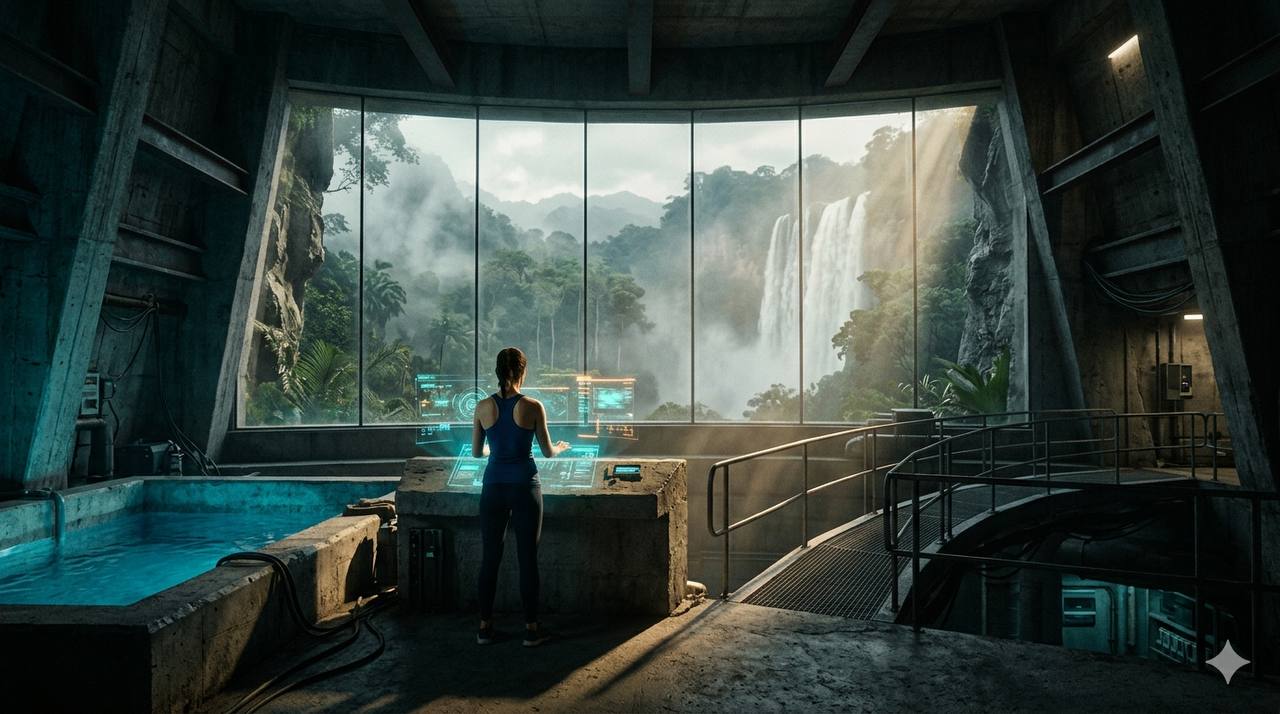
Below ground, Thorne excavated and reinforced a series of concrete bunkers and tunnels, accessible via hidden entrances disguised as natural rock formations or dense brush piles. These underground chambers were climate-controlled, equipped with independent air filtration systems, a water purification plant fed by a subterranean spring, and extensive storage for food, tools, and emergency supplies. Thorne had studied the principles of subterranean architecture and applied them rigorously, ensuring structural integrity and protection from both natural elements and external scrutiny. The entire complex was a testament to his systems architect background, every component meticulously planned for maximum efficiency and stealth.
Security on the property was multi-layered. Beyond the physical fortifications, Thorne employed a network of passive and active measures: buried motion sensors, hidden infrared cameras linked to a local server, and carefully laid tripwires that would alert him to any intrusion without revealing their presence. Waste disposal was managed with an almost obsessive attention to detail, designed to leave no trace. Light pollution was nonexistent; any necessary illumination was internal and carefully shielded. Thorne had cultivated his property to be a
Notes & sources
- · Story is fictional. Names, locations, and events are invented.
This story is a dramatized retelling. Some details, names, and locations have been changed or invented for narrative purposes.