On the afternoon of October 27, 2008, the sky above Alabaster Cove, a remote stretch of coastline near Point Cypress, California, performed an abrupt and unsettling transformation. What had been a clear, late-autumn day fractured into an oppressive, inky blackness. Sarah Thorne, thirty-two years old, had been collecting seashells with her six-year-old son, Leo. Her infant daughter, Elara, slept soundly in a carrier strapped to her back. The sudden descent of night was accompanied by a chilling silence from the ocean, a phenomenon that preceded the true horror. The water, moments before a placid expanse of slate grey, began to recede with unnatural speed, exposing vast tracts of seabed never before seen, scattered with strange, slick marine life.
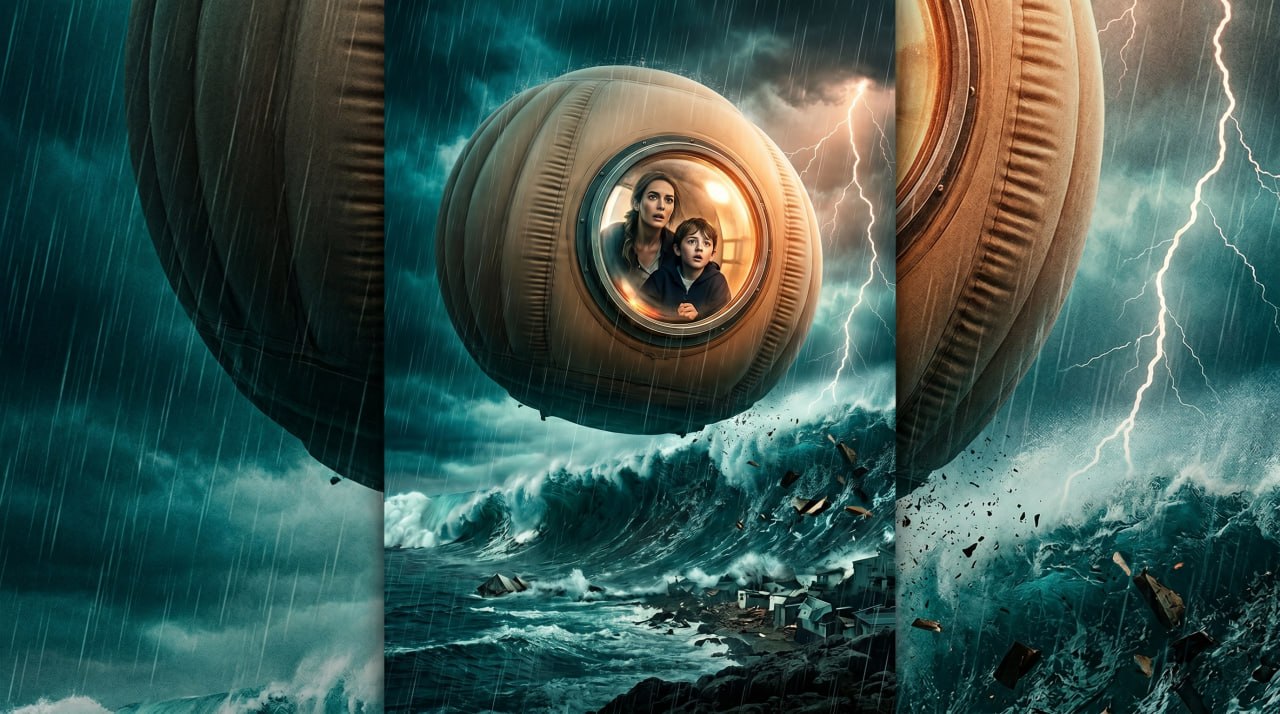
Then, the ocean returned. Not in gentle waves, but as a colossal, dark mountain rising from the horizon. It was a mega-tsunami, an event of impossible scale, tearing towards the shore with an audible roar that swallowed all other sound. Sarah Thorne, amidst the immediate, overwhelming panic, had only one thought: survival. She clutched Leo’s small hand, his face a mask of terror, and instinctively turned to run towards the low bluffs. But the wave was too fast, too immense. Its crest already blotted out the sky. Her eyes, frantic, scanned the beach for any impossible refuge. That was when she saw it: a massive, pearlescent pod, half-buried in the sand near the bleached ribs of a long-dead whale, a structure she had never noticed in her many visits to Alabaster Cove.
The Last Glimpse
The pod was roughly spherical, perhaps fifteen feet in diameter, made of a smooth, seamless material that looked like polished bone. A single, wide opening, like a mouth, gaped on its side. It seemed impossibly out of place, yet in that moment of ultimate desperation, it offered the only conceivable chance. “Leo, go! Get inside!” Sarah screamed, her voice a raw rasp against the rising roar of the wave. She shoved her son towards the opening, propelling his small body through before he could register confusion. With Elara still secured to her back, Sarah scrambled in after him, her heart hammering against her ribs. The interior was surprisingly spacious, lit by a soft, diffused glow from an unseen source. As she hauled herself fully inside, a faint hiss signaled the opening beginning to seal. The pod vibrated, a deep hum thrumming through its walls. The last thing Sarah saw through the narrowing aperture was the towering, frothing wall of water, mere yards away, before the opening closed with a soft, final thud, plunging them into a strangely comforting silence.
Minutes later, or perhaps hours – time became a meaningless concept within the pod – the violent lurching ceased. Sarah, disoriented and soaked, fumbled for Leo, who was whimpering quietly beside her. Elara, miraculously, had slept through the cataclysm. The diffused light inside the pod remained constant, revealing a minimalist environment. There were no visible seams, no controls, no windows. Just smooth, curved walls. As the initial shock began to recede, a panel in the floor hissed open, revealing a small compartment containing vacuum-sealed packs of nutrient paste, purified water, and a stack of soft, warmth-retaining blankets. The pod, it seemed, was self-sufficient. It was designed for survival, but not, Sarah realized with a growing dread, for rescue.
Drifting into the Unknown
Days blurred into a seamless continuum within the pod. Sarah established a routine: feed the children, conserve resources, check the pod’s temperature and air quality – which remained consistently comfortable, despite the unknown external conditions. She spoke to Leo, reassuring him, creating small games to distract him from their confinement. Elara remained placid, an anchor of normalcy in their bewildering predicament. Sarah tried to discern any movement, any sound from outside, but the pod was an impenetrable shell. There was no sensation of drifting, no familiar rocking of ocean currents. It felt as if they were suspended, or perhaps moving with a purpose she could not comprehend.
Food and water replenished themselves, albeit slowly. Each time a packet was consumed, another would eventually appear, maintaining a steady, if meager, supply. The pod was a perfectly calibrated ecosystem for three, a testament to an unknown engineering. Sarah’s attempts to communicate with the outside world were futile. Her phone, soaked during the initial rush, was dead. Even if it had worked, there was no signal, no indication of where they were, or if anyone was even searching for them. The world outside the pod had simply ceased to exist, replaced by an endless, featureless void.
One evening, while Leo slept, Sarah noticed a subtle shimmer on one of the inner walls. When she touched it, the smooth surface rippled, then became transparent, revealing a view of the outside. It was night, a sky ablaze with stars, but not the constellations she knew. Familiar patterns were absent, replaced by strange nebulae and clusters of light. Below them, a vast, black expanse of water stretched to an invisible horizon. They were on the ocean, certainly, but under a different sky. A profound chill settled over Sarah. This was not the Pacific. This was not Earth, at least not as she knew it.
Echoes of Another World
The transparent wall, which Sarah later discovered would activate sporadically and unpredictably, offered fleeting glimpses of their bizarre journey. They moved at remarkable speed, leaving a phosphorescent trail in the alien water. Sarah saw creatures unlike anything in terrestrial biology – bioluminescent leviathans that pulsed with internal light, schools of fish that seemed to be made of pure energy, gliding through the black depths. The pod seemed to navigate around these beings with an almost intelligent precision, never colliding, always observing from a respectful distance. The air pressure and oxygen levels within the pod remained stable, indicating an advanced atmospheric control system, baffling Sarah’s understanding of conventional technology.
The isolation began to wear on Sarah, not just physically, but psychologically. She kept a mental calendar, marking the passage of days, but the lack of external cues made it difficult to maintain. Leo, remarkably resilient, seemed to accept their situation with the innocent pragmatism of a child, often pointing at the shimmering wall when it activated, asking questions Sarah couldn’t answer. Elara remained their quiet, unburdened companion. Sarah found herself talking to the pod itself, whispering questions into its smooth, unresponsive walls, seeking answers about its origin, its purpose, its destination.
One day, she noticed a faint, etched symbol on the floor near where the food compartment opened. It was a spiral, interwoven with angular lines, unlike any human script or emblem she recognized. It was the only decorative or identifying mark she had ever seen inside the pod. She traced it with her finger, a strange sense of reverence washing over her. Was it a brand? A warning? A map? The pod offered no further clues, maintaining its enigmatic silence. It continued its relentless journey, an ark carrying three unwitting passengers through an ocean that defied geography, under stars that defied astronomy.
The Long Voyage Home (or not)
Weeks turned into months. Sarah estimated they had been inside the pod for over four months, though her sense of time was increasingly unreliable. The children were growing, their faces etched with the quiet resilience that comes from an existence defined by endless travel through the unknown. Leo, now nearly seven, had learned to interpret the pod’s subtle hums and vibrations, sometimes announcing a shift in their trajectory before Sarah even noticed it. He drew pictures on the walls with a small crayon from the survival kit, depicting the strange fish and stars he saw through the transparent membrane, his imagination adapting to their extraordinary reality.
The pod never stopped. It did not land on any shore, did not encounter other vessels, nor did it offer any discernible sign of returning to the world Sarah knew. It was a perpetual motion machine, a self-contained universe, moving with a singular, unalterable purpose. Sarah often sat by the wall when it became transparent, gazing out at the impossible vistas, the ever-changing alien constellations, the silent, majestic movements of creatures from another realm. She had stopped trying to understand, had simply resigned herself to the journey. The mystery of the pod, of their disappearance from Alabaster Cove, remained absolute. They were travelers, not by choice, but by the will of an unknown intelligence, moving inexorably towards a destination that was perhaps beyond human comprehension, or perhaps, simply, nowhere at all. The last anyone saw of the Thorne family was the towering wave, but their journey had only just begun.
Notes & sources
- · Story is fictional. Names, locations, and events are invented.
This story is a dramatized retelling. Some details, names, and locations have been changed or invented for narrative purposes.