On May 17, 2242, at approximately 03:00 local time, Scout Elias Vance reported a breach of perimeter defenses at Sector Gamma-7, within the Old Haven exclusion zone. The transmission, garbled by atmospheric interference, conveyed a single, urgent message: ‘They’re here. Too many.’ Vance and his two-person team, designated ‘Vanguard 3’, had been tasked with a reconnaissance and retrieval mission deep within the city’s skeletal remains, a place long abandoned to the encroaching blight and its restless inhabitants. Their objective: a hardened data core rumored to contain pre-collapse research on environmental remediation, located within the central administrative complex.
The Breach at Gamma-7
The initial infiltration had been meticulously planned, relying on the predictable, if unsettling, dormancy of the ‘Husk-Walkers’ during the pre-dawn hours. Vance, alongside Specialist Lena Petrova and Ordnance Technician Kaelen Thorne, had navigated the fractured streets of Old Haven for seventeen hours, their Geiger counters ticking a steady, low rhythm against the pervasive silence. The city itself was a testament to rapid decay: skyscrapers reduced to jagged teeth, roadways choked with pulverized concrete and ash, and a persistent, metallic tang in the stagnant air. Their primary contact with command, a high-altitude drone named ‘Sentinel-9’, had maintained sporadic visual confirmation.
At Sector Gamma-7, a former residential district bordering the primary research campus, the team encountered the first deviation. Petrova, scanning a collapsed overpass with her thermal optics, identified a cluster of thermal signatures—far more numerous and active than anticipated. ‘Contact, five o’clock low, moving fast,’ she reported, her voice hushed. Before Vance could issue a command, the low growl, a sound like gravel grinding against bone, became audible above the drone’s distant hum. The creatures, indistinct in the perpetual gloom of the exclusion zone, began to emerge from the skeletal apartment blocks. They moved with a disturbing, disjointed gait, their forms suggesting a grotesque mimicry of human locomotion. The team had underestimated their nocturnal mobility.
Vance initiated a tactical retreat, ordering Thorne to deploy a sonic deterrent. The device emitted a high-frequency pulse, momentarily disorienting a few of the leading forms, but the horde behind them pressed forward, their numbers appearing to swell from the very shadows. Petrova’s pulse hammered against her temples as she fired controlled bursts from her energy rifle, the shots carving temporary gaps in the advancing mass. Thorne, struggling to cycle another sonic charge, glanced at Vance, a silent question in his eyes. The mission parameters were clear: retrieve the data core. But survival, at that moment, was the only imperative.
The Flare’s Grim Beacon
The situation rapidly deteriorated. The ‘Husk-Walkers’, despite their shambling appearance, demonstrated a disturbing tenacity. Their numbers, previously estimated in dozens, now seemed to extend into the hundreds, a wave of decrepit forms flowing through the ruins. Vance knew their limited ammunition and dwindling energy cells would not hold against such an assault. He keyed his comm unit, his voice strained. ‘Command, Vanguard 3. Requesting immediate extraction vector. Overrun at Gamma-7. Repeat, overrun.’ The response was static, a distant crackle confirming the atmospheric interference. Sentinel-9’s feed showed only a swirling mass of red thermal signatures.
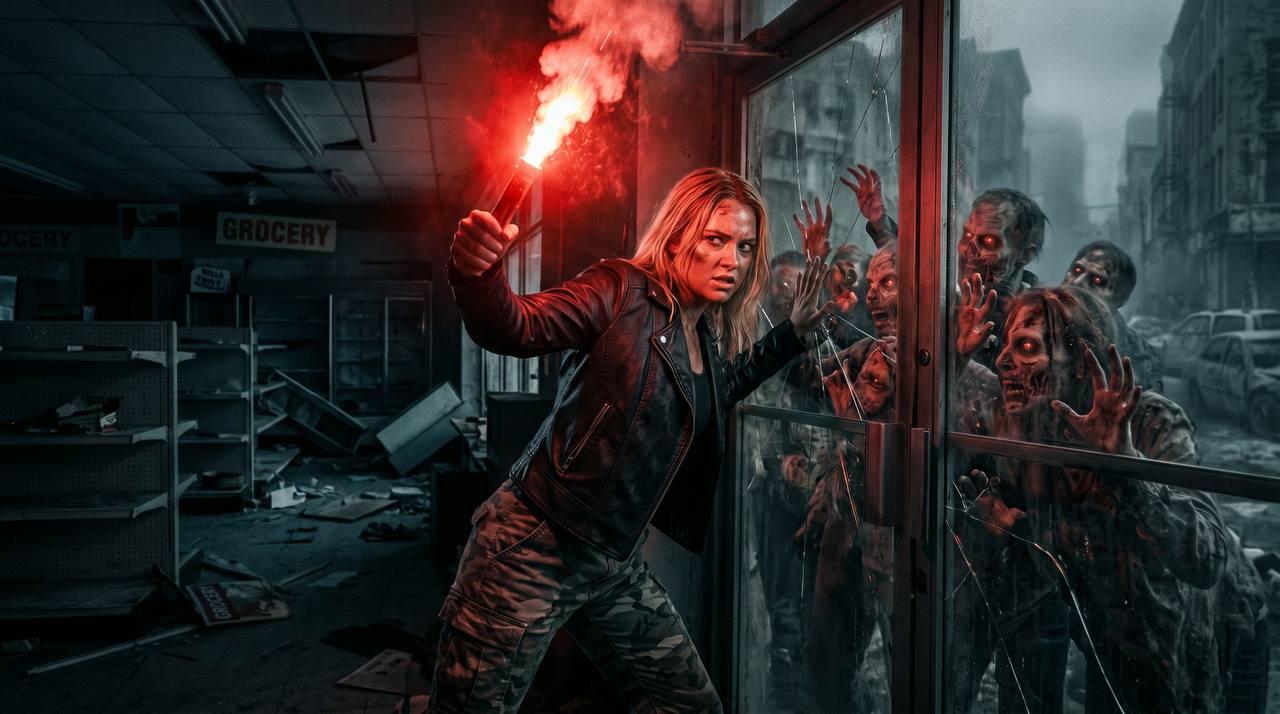
‘Flare!’ Petrova yelled, pointing towards the zenith. A solitary red beacon ignited the pre-dawn sky, arcing high above the central administrative complex. It was the signal: an emergency extraction point, manually activated by a secondary recon team or, more likely, an automated failsafe. The problem was not the signal itself, but its unintended consequence. As the flare burned, casting long, dancing shadows across the devastated cityscape, it illuminated the true scale of the horror. The ‘Husk-Walkers’ did not react to the light with aversion or hesitation; instead, they seemed to orient towards it, their guttural growls intensifying into a collective, hunger-driven chorus. The flare, intended as a beacon of hope, had become a grim magnet, drawing every restless entity in the vicinity.
Vance made a snap decision. ‘Thorne, demolition charges. We’re cutting a path.’ Their original route to the data core was now impassable. He pointed towards a partially collapsed service tunnel entrance, half-buried beneath a mountain of rubble. It was a risky proposition, leading deeper into the unknown underbelly of Old Haven, but it was their only immediate recourse. Thorne, without hesitation, primed two thermal charges and expertly placed them against the debris, creating a controlled, deafening blast that carved a narrow opening into the darkness below. The ground trembled. Dust and debris rained down. As the horde surged towards the new breach, Vance, Petrova, and Thorne plunged into the subterranean depths, the metallic door of the service tunnel groaning shut behind them, sealing them away from the immediate, overwhelming threat, but towards another, perhaps greater, unknown.
Descent into the Earth
The air immediately changed below ground. The acrid tang of ash and decay was replaced by a cloying, earthy smell, thick with dampness and something else, something subtly vegetal and metallic, like old blood and wet soil. The darkness was absolute, broken only by the narrow beams of their tactical flashlights, which cut through the oppressive blackness like thin surgical instruments. The service tunnel, a labyrinth of rusted pipes and defunct conduits, sloped downward at a steep angle, its concrete walls weeping with condensation. The distant sounds of the horde above faded into a muffled, persistent thrum, a reminder of the impossible situation they had just escaped.
Petrova, using a handheld scanner, identified structural integrity issues. ‘Old construction, deep foundation. Could be unstable,’ she reported, her voice hushed, echoing eerily in the confined space. Thorne, ever practical, began to mark their path with luminous chemical sticks, a slim hope of finding their way back if a retreat was ever possible. Vance, leading the descent, felt the weight of their predicament. They were no longer pursuing the data core; they were simply surviving, driven deeper by an instinct to escape the surface. The temperature dropped steadily, and a strange, cold draft snaked through the tunnels, carrying with it that peculiar, earthy scent.
After what felt like hours, the tunnel widened into a series of larger, interconnected chambers. These were not mere service ducts but seemed to be part of an older, perhaps abandoned, section of the facility. The architecture was different, less utilitarian, more robust, suggesting a pre-dating purpose. Faint, indecipherable symbols were etched into some of the stone-like walls, partially obscured by mineral deposits and a creeping, blackish mold. The mold itself pulsed faintly with an internal luminescence, a soft, unsettling glow that cast grotesque shadows. It was in one of these chambers that Thorne’s flashlight beam swept over a rusted placard, barely legible: ‘Section 4: Subterranean Cultivation & Containment.’ The word ‘cultivation’ hung in the air, unsettling.
The Archives of Despair
They pressed on, the silence punctuated only by their own breathing and the occasional drip of water. The black mold became more prevalent, a dense, carpet-like growth covering floors and walls, occasionally forming strange, fruiting bodies that resembled dark, petrified flowers. The air grew heavier, the earthy-metallic scent more potent. They finally reached a larger complex of rooms that appeared to be some form of subterranean research facility, distinct from the administrative complex they had initially targeted. This area seemed to predate the main Old Haven construction, suggesting a layer of history buried beneath the known.
One room, eerily preserved despite the pervasive mold, contained banks of ancient, non-functional servers and data terminals. On a cracked console, a series of logs were still faintly visible on a dim, flickering screen, powered by what must have been an isolated, emergency generator. Petrova, ever the specialist, began to extract what data she could onto a portable drive. The logs, dated over a century prior to the collapse of Old Haven, spoke of ‘anomalous biological growth,’ ‘sub-strata contamination,’ and ‘unprecedented cellular regeneration.’ There were references to ‘the Root,’ described not as a plant, but as a vast, interconnected neural network capable of influencing organic matter. The term ‘Husk-Walkers’ appeared frequently, not as a designation for reanimated corpses, but for organisms whose minds had been subsumed by this ‘Root’ and repurposed as its mobile extensions.
The logs detailed failed containment protocols, escalating mutations, and a growing despair among the researchers. One entry, dated mere days before the official ‘quarantine’ of Old Haven, read: ‘The Root adapts. It learns. It thinks. The surface creatures are merely its appendages, its eyes and ears. The true horror lies deeper, where the primary biomass connects. We have only scratched the surface of its intelligence. God help us.’ The implication was chilling: the horde above was not just a collection of mindless undead, but a coordinated, evolving entity, a part of something far larger and more sinister, a collective consciousness rooted beneath the city.
The Wellspring
The data Petrova recovered revealed a map, crude and ancient, pointing further downward, past the research labs, to a chamber simply marked ‘Nexus.’ Driven by a morbid curiosity and the desperate need to understand their enemy, Vance decided they would proceed. The tunnel leading to the Nexus was narrow, almost claustrophobic, the black mold growing in thick, pulsing veins along the walls, occasionally contracting and expanding as if breathing. The air became thick, almost viscous, and the strange metallic-earthy scent intensified, now mixed with something acrid, like ozone.
They emerged into a vast, cavernous space. Here, the mold was not merely a growth; it was the dominant feature. It formed colossal, organic structures, like petrified trees reaching for a nonexistent sky, their branches interweaving to create an intricate, living canopy. At the center of the chamber, a dark, viscous pool pulsed with a faint, internal light, reflecting off the slick, obsidian-like surfaces of the surrounding growth. This was the ‘Nexus,’ the primary biomass, the ‘Wellspring’ of the Root. From its depths, tendrils of the black mold snaked out, disappearing into cracks in the rock, undoubtedly connecting to the entire exclusion zone, perhaps even beyond. It was a single, vast, interconnected organism, and the ‘Husk-Walkers’ were merely its motile projections.
As they stood on a narrow precipice overlooking the wellspring, a low, resonant hum emanated from the pool, a sound that seemed to vibrate in their very bones, bypassing their ears and resonating directly with their nervous systems. It was not a sound of pain or aggression, but of immense, ancient intelligence, a collective consciousness that had been slumbering, perhaps, for millennia, now fully awakened. The ‘Husk-Walkers’ above were merely the first stirrings of its vast, unseen body. The data core, their original mission, seemed utterly irrelevant in the face of this revelation. Their small, desperate fight on the surface had been against a single, exposed nerve ending of something truly monumental.
Retreat from the Maw
The hum intensified, and faint, translucent filaments began to rise from the surface of the wellspring, drifting towards them like ethereal spores. Vance did not need to issue an order. The three of them turned, their movements synchronized by a primal understanding of the profound danger they faced. The mission was no longer about retrieval; it was about survival, about carrying the horrifying truth of the Root back to whatever remained of civilization. The return path through the mold-choked tunnels, which had seemed merely dark and confined on the way down, now felt like navigating the arteries of a colossal, predatory organism.
They did not know if they could escape the Nexus, let alone the exclusion zone. They did not know how vast the Root truly was, or how far its influence extended. The surface, with its ash and its swarms of ‘Husk-Walkers’, now seemed like a mere prelude to the true, fundamental horror that lay coiled in the depths of the earth, an ancient intelligence slowly, inexorably, stretching its tendrils towards the light.
Notes & sources
- · Story is fictional. Names, locations, and events are invented.
This story is a dramatized retelling. Some details, names, and locations have been changed or invented for narrative purposes.