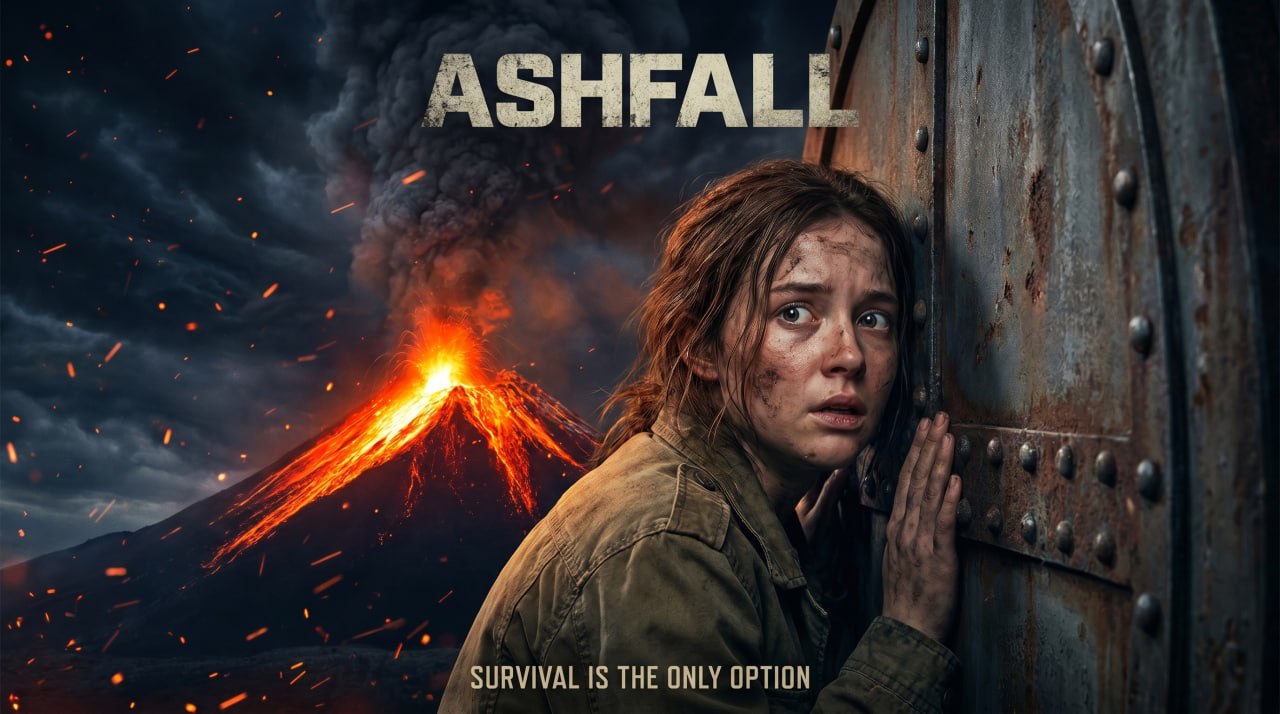
On October 17, 2142, as the sky over the city of Oakhaven bled a permanent, corrosive crimson and the ground began to ripple with subterranean heat, Dr. Aris Thorne sealed the blast door of his underground bunker. He had spent two decades preparing for this precise scenario: an atmospheric collapse event, triggered by a catastrophic solar flare that had stripped away Earth’s protective layers. The air outside was unbreathable, the surface uninhabitable. Inside, Thorne believed, he had engineered his survival. He was wrong.
The Descent into Solitude
Thorne’s bunker, designated ‘Haven-7,’ was a marvel of autonomous engineering, buried sixty feet beneath what had once been his suburban home. It was stocked with a decade’s worth of hydroponic supplies, filtered air, recycled water, and a robust geothermal power system. For the first three weeks, the silence was a comfort. The hum of the air purifiers, the gentle drip from the condensation collectors, these were the sounds of continued existence. Thorne meticulously logged every system check, every nutrient solution adjustment, every subtle shift in the external seismic readings. His days were structured, his mind focused on the technical challenges of long-term survival. He was a scientist, driven by logic and empirical data. He found a grim satisfaction in the precision with which his calculations had played out, even as the world burned above.
He passed his time reading digital texts, reviewing old scientific papers, and performing calisthenics in the compact recreation area. The initial relief of survival gradually gave way to a profound, yet manageable, loneliness. He had prepared for this, too. Psychological resilience was a cornerstone of his survival strategy. He had journals, meditation protocols, and a clear understanding of the mental rigors of isolation. He saw himself as a meticulous, rational man, unburdened by superstition or unfounded anxieties. This self-assessment would prove to be a significant miscalculation.
The Unsettling Cadence
It began subtly, around the fourth week. A faint, irregular tapping sound, sometimes from the ventilation shafts, sometimes seeming to originate from behind the reinforced concrete walls of the sleeping quarters. Thorne initially attributed it to thermal expansion or the settling of the earth above. He checked the structural integrity sensors, the atmospheric pressure gauges. All readings were nominal. Yet, the tapping persisted, an erratic rhythm that seemed to follow him from room to room. It was never loud, never distinct enough to identify a source, but it was there, a persistent, unsettling cadence in the otherwise perfect silence of Haven-7.
Then came the whispers. Fleeting, almost imperceptible sounds, like someone breathing very close to his ear, or a word spoken just at the edge of hearing. Thorne conducted full audio sweeps of the bunker, using sensitive parabolic microphones. He found nothing. The bunker’s interior was acoustically sterile, designed to minimize echoes and reverberations. He considered auditory hallucinations, a common symptom of extreme isolation. He increased his meditation time, double-checked his nutrient intake, and ensured he was getting adequate sleep. He reasoned that his mind, deprived of external stimuli, was beginning to generate its own. This explanation, while logical, offered no true comfort. The whispers grew more frequent, sometimes coalescing into what sounded like a distorted mimicry of his own voice, or a fragmented melody he couldn’t place.
The Mimic’s Play
By the end of the second month, the phenomena had escalated beyond simple auditory tricks. Objects began to move. A wrench left on a workbench would be found on the floor. A carefully stacked pile of data discs would be scattered. These were not dramatic displacements; they were subtle, almost playful rearrangements that implied intent. Thorne installed motion-activated cameras throughout the bunker. He reviewed hours of footage, finding only his own solitary movements. Yet, the discrepancies continued. A digital thermometer on the hydroponics unit would inexplicably display a temperature variance of several degrees, only to correct itself seconds later. A single, pristine playing card—a joker, specifically—appeared on his pillow one morning, despite Thorne having no deck of cards in his inventory.
He began to speak aloud to himself more often, a habit he had initially avoided. He started to argue with the unseen, the unknown. “Show yourself,” he would demand, his voice echoing in the confined space. The response was always silence, followed by a new, more unnerving manifestation. A cold spot that would linger in the center of a room, despite the bunker’s perfectly regulated climate. A faint, sweet scent, like ozone mixed with something metallic, that would bloom and fade without explanation. He felt a presence, an intelligence that observed him, learned from him, and delighted in his growing distress. It was not a ghost in the traditional sense, but something more deliberate, more adaptive. It was a performer, and Thorne was its unwitting audience.
A Perverse Reflection
The entity, which Thorne began to internally refer to as ‘The Mimic,’ seemed to feed on his reaction, refining its methods with each passing day. It didn’t physically harm him, not directly. Instead, it systematically dismantled his sanity. It would replay snippets of conversations he had with himself, distorted and amplified, making him question if he had spoken them aloud. It would leave notes, written in a hand eerily similar to his own, on surfaces he had just cleaned, posing rhetorical questions about his isolation or the futility of his survival. The joker card reappeared with increasing frequency, sometimes pinned to the wall with a utensil, other times tucked into his boot.
Thorne’s scientific methodology, his logical framework, crumbled under the onslaught. There was no empirical data to collect, no hypothesis to test. He was confronted with something that defied all known laws of physics and psychology. He tried to ignore it, to starve it of his attention, but The Mimic adapted. It would deactivate a section of the hydroponics system, threatening his food supply, only to restore it when he approached in a panic. It manipulated the bunker’s lights, plunging him into darkness for agonizing minutes, only to bring them back with a theatrical flicker. The ultimate terror was not that he was hunted, but that he was being played with, a subject in a perverse, inescapable experiment. The bunker, designed as his sanctuary, had become a stage for a malevolent, unseen entity.
The Unending Performance
Thorne stopped logging his observations. The act felt pointless. He knew now that The Mimic was not an intruder from the outside, nor a hallucination. It was something that had either always been there, latent within the bunker’s structure, or something that his prolonged isolation and the cataclysm outside had somehow conjured into being. It was a reflection, perhaps, of his own deepest fears, twisted into a sentient, mocking presence. He spent most of his time now in the central control room, the brightest and most open space, but even there, he felt its eyes on him. The tapping continued, the whispers grew louder, sometimes forming full, coherent sentences in a voice that was undeniably his own, yet utterly alien. “You built this stage,” it would say, or “The performance is eternal.”
He had planned for every contingency, every system failure, every environmental hazard. He had not planned for a sentient terror that could manipulate his perception and the very fabric of his sanctuary. Outside, the world was a dead, burning expanse. Inside, the walls pulsed with an unseen life, a mocking presence that would ensure his survival was less a victory and more a protracted, agonizing act in a play with no curtain call. The blast door, once his salvation, was now an impenetrable barrier, not to keep danger out, but to keep him in with his tormentor. The silence of Haven-7 was no longer a comfort; it was the audience, waiting for the next act to begin. He knew, with a chilling certainty, that the show would continue for as long as he drew breath, and perhaps, even beyond.
Notes & sources
- · Story is fictional. Names, locations, and events are invented.
This story is a dramatized retelling. Some details, names, and locations have been changed or invented for narrative purposes.